


Real CAS-005 dumps - Real CompTIA dumps PDF in here [Apr-2025]
Realistic VCE4Dumps CAS-005 Dumps PDF - 100% Passing Guarantee
CompTIA CAS-005 Exam Syllabus Topics:
| Topic | Details |
|---|---|
| Topic 1 |
|
| Topic 2 |
|
| Topic 3 |
|
| Topic 4 |
|
NEW QUESTION # 99
A software vendor provides routine functionality and security updates to its global customer base.
The vendor would like to ensure distributed updates are authorized, originate from only the company, and have not been modified by others. Which of the following solutions best supports these objectives?
- A. File integrity monitoring
- B. Code signing
- C. Application control
- D. Envelope encryption
Answer: B
NEW QUESTION # 100
A company needs to increase the maturity level for the cybersecurity department's governance structure.
To achieve this goal, the company wants to implement a set of controls that can be used as part of the standard operational procedures and policies within the department and the company.
Which of the following frameworks best aligns with this goal?
- A. ITIL
- B. COSO
- C. COBIT
- D. CIS
Answer: C
NEW QUESTION # 101
After a cybersecurity incident, a security analyst was able to collect a binary that the attacker used on the compromised server. Then the analyst ran the following command:
Which of the following options describes what the analyst is trying to do?
- A. To debug the binary to analyze low-level instructions
- B. To extract IoCs from the binary used on the attack
- C. To reconstruct the timeline of commands executed by the binary
- D. To replicate the attack in a secure environment
Answer: B
NEW QUESTION # 102
A security analyst reviews the following report:
Which of the following assessments is the analyst performing?
- A. Organizational
- B. System
- C. Supply chain
- D. Quantitative
Answer: C
Explanation:
The table shows detailed information about products, including location, chassis manufacturer, OS, application developer, and vendor. This type of information is typically assessed in a supply chain assessment to evaluate the security and reliability of components and services from different suppliers.
Why Supply Chain Assessment?
Component Evaluation: Assessing the origin and security of each component used in the products, including hardware, software, and third-party services.
Vendor Reliability: Evaluating the security practices and reliability of vendors involved in providing components or services.
Risk Management: Identifying potential risks associated with the supply chain, such as vulnerabilities in third-party components or insecure development practices.
NEW QUESTION # 103
A security team receives an escalated support ticket for a user who is unable to access specific corporate resources. The following configurations exist in the corporation:
- A device certificate is deployed on all corporate assets.
- Templates for unique user certificates are configured.
- Security updates are installed every 30 days.
- Administrator access is tied to specific hosts.
The ticket contains the following observations:
- The user has been on leave for more than 90 days.
- Internal vulnerability scans indicate no device issues.
- Single sign-on works as expected.
- Privileged systems are not accessible.
Which of the following best describes the root cause?
- A. Incorrect certificate extensions have been added to the templates.
- B. The user's administrator credentials likely expired after 90 days.
- C. Several patch cycles have been missed while the user was on leave.
- D. The device being utilized does not have user binding established.
Answer: B
NEW QUESTION # 104
A security engineer is performing threat modeling for an AI training architecture. The architecture implements a CI/CD pipeline to train a new AI model on a fixed schedule with live data from a back-end storage location. The engineer wants to use a threat modeling activity to focus on the threat as it moves through the CI/CD pipeline to the production environment. Which of the following is the most appropriate action for the engineer to take?
- A. Execute automated code reviews.
- B. Map to OWASP Top 10.
- C. Identify trust boundaries.
- D. Document data flows.
Answer: C
NEW QUESTION # 105
A security administrator is reviewing the following code snippet from a website component:
A review of the inc.tmp file shows the following:
Which of the following is most likely the reason for inaccuracies?
- A. A search engine's bots are being blocked at the firewall.
- B. The relevant stylesheet has become corrupted.
- C. The WAF is configured to be in transparent mode.
- D. A content management solution plug-in has been exploited.
Answer: D
NEW QUESTION # 106
A security analyst Detected unusual network traffic related to program updating processes The analyst collected artifacts from compromised user workstations. The discovered artifacts were binary files with the same name as existing, valid binaries but. with different hashes which of the following solutions would most likely prevent this situation from reoccurring?
- A. Allowing only dies from internal sources
- B. Implementing digital signature
- C. Performing manual updates via USB ports
- D. Improving patching processes
Answer: B
Explanation:
Implementing digital signatures ensures the integrity and authenticity of software binaries. When a binary is digitally signed, any tampering with the file (e.g., replacing it with a malicious version) would invalidate the signature. This allows systems to verify the origin and integrity of binaries before execution, preventing the execution of unauthorized or compromised binaries.
* A. Improving patching processes: While important, this does not directly address the issue of verifying the integrity of binaries.
* B. Implementing digital signatures: This ensures that only valid, untampered binaries are executed, preventing attackers from substituting legitimate binaries with malicious ones.
* C. Performing manual updates via USB ports: This is not practical and does not scale well, especially in large environments.
* D. Allowing only files from internal sources: This reduces the risk but does not provide a mechanism to verify the integrity of binaries.
References:
* CompTIA Security+ Study Guide
* NIST SP 800-57, "Recommendation for Key Management"
* OWASP (Open Web Application Security Project) guidelines on code signing
NEW QUESTION # 107
A company's help desk is experiencing a large number of calls from the finance department slating access issues to www.bank.com. The security operations center reviewed the following security logs:
Which of the following is most likely the cause of the issue?
- A. The DNS was set up incorrectly.
- B. DNS traffic is being sinkholed.
- C. The DNS record has been poisoned.
- D. Recursive DNS resolution is failing
Answer: B
Explanation:
Sinkholing, or DNS sinkholing, is a method used to redirect malicious traffic to a safe destination.
This technique is often employed by security teams to prevent access to malicious domains by substituting a benign destination IP address.
In the given logs, users from the finance department are accessing www.bank.com and receiving HTTP status code 495. This status code is typically indicative of a client certificate error, which can occur if the DNS traffic is being manipulated or redirected incorrectly. The consistency in receiving the same HTTP status code across different users suggests a systematic issue rather than an isolated incident.
NEW QUESTION # 108
A security engineer added a new server to the company email cluster. The server has a new external IP address associated with it. After a few days, the service desk started receiving complaints from users about their outgoing messages to customers being flagged as spam.
Which of the following records should the security engineer update to fix the issue? (Choose two.)
- A. DMARC
- B. MIME
- C. SPF
- D. PTR
- E. CNAME
- F. MX
Answer: C,D
NEW QUESTION # 109
A customer requires secure communication of subscribed web services at all times, but the company currently signs its own certificate requests to an internal CA.
Which of the following approaches will best meet the customer's requirements?
- A. Request a software signing certificate from a public CA.
- B. Process a CSR for a server authentication certificate.
- C. Generate a CSR to the local CA for email encryption.
- D. Submit a CSR for a wildcard certificate to a public CA.
Answer: B
Explanation:
Server authentication certificates are used to secure web communication (e.g., HTTPS).
Submitting a CSR (Certificate Signing Request) for a server authentication certificate ensures the web services can securely establish encrypted communication. Other options, such as email encryption or software signing, do not apply in this scenario.
NEW QUESTION # 110
SIMULATION
An organization is planning for disaster recovery and continuity of operations.
INSTRUCTIONS
Review the following scenarios and instructions. Match each relevant finding to the affected host.
After associating scenario 3 with the appropriate host(s), click the host to select the appropriate corrective action for that finding.
Each finding may be used more than once.
If at any time you would like to bring back the initial state of the simulation, please click the Reset All button.
Answer:
Explanation: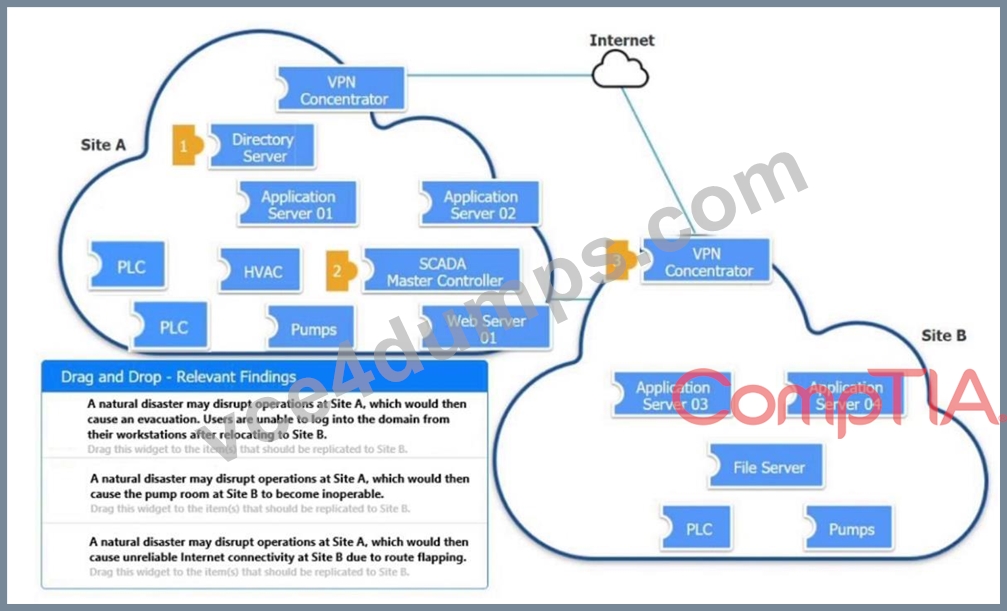
Explanation:
Given that there is little connection between the two clouds when site A is down and cause an evacuation I would say directory server is damaged causing domain issues. 1 - Directory Server.
SCADA system controls the pumps so 2 - SCADA. Last is route flapping that is VPN concentrator, now dont make the mistake i did put 3 in site B not A as for the added option used the BGP routing, if bgp route is set to go through site A that might cause issues so 3 - VPM Concentrator (Site B) (BGP route option).
NEW QUESTION # 111
A security team is responding to malicious activity and needs to determine the scope of impact the malicious activity appears to affect certain version of an application used by the organization Which of the following actions best enables the team to determine the scope of Impact?
- A. Analyzing user behavior
- B. Reviewing the asset inventory
- C. Performing a port scan
- D. Inspecting egress network traffic
Answer: B
Explanation:
Reviewing the asset inventory allows the security team to identify all instances of the affected application versions within the organization. By knowing which systems are running the vulnerable versions, the team can assess the full scope of the impact, determine which systems might be compromised, and prioritize them for further investigation and remediation.
Performing a port scan (Option A) might help identify open ports but does not provide specific information about the application versions. Inspecting egress network traffic (Option B) and analyzing user behavior (Option D) are important steps in the incident response process but do not directly identify which versions of the application are affected.
References:
* CompTIA Security+ Study Guide
* NIST SP 800-61 Rev. 2, "Computer Security Incident Handling Guide"
* CIS Controls, "Control 1: Inventory and Control of Hardware Assets" and "Control 2: Inventory and Control of Software Assets"
NEW QUESTION # 112
A security audit of a company's application finds that customer account passwords are manually set and never expire. The company wants to fix the password issue on a minimal budget within
30 days while minimizing the impact to customers. Which of the following should the company do?
- A. Migrate authentication methods to allow for OAuth 2.
- B. Configure a privilege access management solution.
- C. Implement a self-service credential reset portal.
- D. Contact each user to reset their password.
Answer: C
NEW QUESTION # 113
A cloud engineer needs to identify appropriate solutions to:
- Provide secure access to internal and external cloud resources.
- Eliminate split-tunnel traffic flows.
- Enable identity and access management capabilities.
Which of the following solutions arc the most appropriate? (Select two).
- A. PAM
- B. SASE
- C. SD-WAN
- D. Federation
- E. Microsegmentation
- F. CASB
Answer: B,F
Explanation:
To provide secure access to internal and external cloud resources, eliminate split-tunnel traffic flows, and enable identity and access management capabilities, the most appropriate solutions are CASB (Cloud Access Security Broker) and SASE (Secure Access Service Edge).
Why CASB and SASE?
CASB (Cloud Access Security Broker):
Secure Access: CASB solutions provide secure access to cloud resources by enforcing security policies and monitoring user activities.
Identity and Access Management: CASBs integrate with identity and access management (IAM) systems to ensure that only authorized users can access cloud resources.
Visibility and Control: They offer visibility into cloud application usage and control over data sharing and access.
SASE (Secure Access Service Edge):
Eliminate Split-Tunnel Traffic: SASE integrates network security functions with WAN capabilities to ensure secure access without the need for split-tunnel configurations.
Comprehensive Security: SASE provides a holistic security approach, including secure web gateways, firewalls, and zero trust network access (ZTNA).
Identity-Based Access: SASE leverages IAM to enforce access controls based on user identity and context.
NEW QUESTION # 114
A security analyst received a report that an internal web page is down after a company-wide update to the web browser. Given the following error message:
Which of the following is the best way to fix this issue?
- A. Blocking all non-essential pons
- B. Discontinuing the use of self-signed certificates
- C. Disabling all deprecated ciphers
- D. Rewriting any legacy web functions
Answer: B
Explanation:
The error message "NET::ERR_CERT_WEAK_SIGNATURE_ALGORITHM" indicates that the web browser is rejecting the certificate because it uses a weak signature algorithm. This commonly happens with self-signed certificates, which often use outdated or insecure algorithms.
Why Discontinue Self-Signed Certificates?
Security Compliance: Modern browsers enforce strict security standards and may reject certificates that do not comply with these standards.
Trusted Certificates: Using certificates from a trusted Certificate Authority (CA) ensures compliance with security standards and is less likely to be flagged as insecure.
Weak Signature Algorithm: Self-signed certificates might use weak algorithms like MD5 or SHA-1, which are considered insecure.
NEW QUESTION # 115
A systems administrator wants to reduce the number of failed patch deployments in an organization. The administrator discovers that system owners modify systems or applications in an ad hoc manner. Which of the following is the best way to reduce the number of failed patch deployments?
- A. Situational awareness
- B. Quality assurance
- C. Compliance tracking
- D. Change management
Answer: D
Explanation:
To reduce the number of failed patch deployments, the systems administrator should implement a robust change management process. Change management ensures that all modifications to systems or applications are planned, tested, and approved before deployment. This systematic approach reduces the risk of unplanned changes that can cause patch failures and ensures that patches are deployed in a controlled and predictable manner.
References:
* CompTIA SecurityX Study Guide: Emphasizes the importance of change management in maintaining system integrity and ensuring successful patch deployments.
* ITIL (Information Technology Infrastructure Library) Framework: Provides best practices for change management in IT services.
* "The Phoenix Project" by Gene Kim, Kevin Behr, and George Spafford: Discusses the critical role of change management in IT operations and its impact on system stability and reliability.
NEW QUESTION # 116
......
Verified CAS-005 dumps Q&As Latest CAS-005 Download: https://www.vce4dumps.com/CAS-005-valid-torrent.html
Free CompTIA CAS-005 Exam Questions and Answer: https://drive.google.com/open?id=1m7wgw1sJy0eV80BtkcmDIs8bw8M2neCs