


Updated Apr-2023 Test Engine or PDF for the Oracle 1Z0-821 test to help you quickly prepare for the Oracle exam!
Full 1Z0-821 Practice Test and 245 unique questions with explanations waiting just for you, get it now!
NEW QUESTION # 23
You need to update an OS image on a client. The pkg publishers command displays the wrong publisher with the wrong update:
PUBLISHERTYPESTATUSURI
Solaris origin onlinehttp://pkg.oracle.com/solaris/release
The update is available on the updated publisher:
PUBLISHERTYPESTATUSURI
Solaris originonlinehttp://sysA.example.com
Select the option that describes the procedure used to update the OS image on the system from the updated publisher.
- A. Configure the publisher on the client using the svcfg - s command so that the Solaris publisher
is connected to the repository at http://sysA.example.com
Refresh the application/pkg/server service.
Issue the pkgrepo refresh command to repository catalog - B. Copy the repository from the ISO image onto the local client.
Configure the repository on the client by using the svccfg - s command so that the Solaris
publisher is connected to the new repository.
Refresh the application/pkg/server service.
Issue the pkgrepo refresh command to refresh the repository catalog - C. Use the pkg set-publisher command to change the URL of the publisher Solaris to
http://sysA.example.com.
Issue the pkg update command to update the OS image. - D. Add the new publisher http://sysA.example.com Solaris
Use the pkg set-publisher command to set the publisher search order and place
http://sysA.example.com of http://pkg.oracle.com/solaris/release
Issue the pkg publisher command to view the publishers.
Set the new publisher to sticky.
Issue the pkg update command to update the OS image.
Answer: C
Explanation:
You can use the pkg set-publisher command to change a publisher URI.
Changing a Publisher Origin URI
To change the origin URI for a publisher, add the new URI and remove the old URI. Use the -g
option to add a new origin URI. Use the -G option to remove the old origin URI.
# pkg set-publisher -g http://pkg.example.com/support \
-G http://pkg.example.com/release example.com
Note: You can use either the install or update subcommand to update a package.
The install subcommand installs the package if the package is not already installed in the image. If
you want to be sure to update only packages that are already installed, and not install any new
packages, then use the update subcommand.
Reference: Oracle Solaris 11 Express Image Packaging System Guide, Managing Package
Publishers
NEW QUESTION # 24
The crash dump notification on your server is: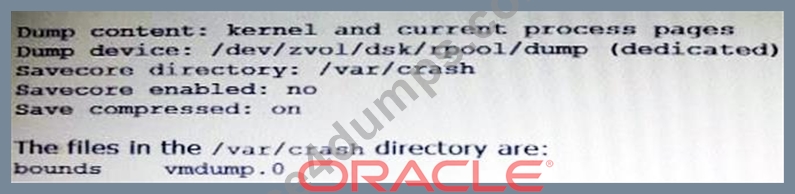
Documentation states that there should be two core files for each crash dump in the
/var/crash directory named vmdump.0
Which command should you choose to display theses two files?
- A. dumpadm -z off
- B. savecore -f vmdump.0
- C. dumpadm uncompressed
- D. gunzip vmdump.0
Answer: B
Explanation:
Decompress using savecore -f vmdump.0
savecore - save a crash dump of the operating system
-f dumpfile Attempt to save a crash dump from the specified file instead of from the system's current dump device. This option may be useful if the information stored on the dump device has been copied to an on-disk file by means of the dd(1M) command.
NEW QUESTION # 25
Your SPARC server will not boot into multi user-server milestones and you need to troubleshoot to out why. You need to start the server with minimal services running so that you can go through each milestone manually to troubleshoot the issue.
Select the option that boots the server with the fewest services running.
- A. boot -m none
- B. boot -m milestone=single-user
- C. boot -s
- D. boot -m milestone=none
- E. boot milestone none
Answer: D
Explanation:
The command boot -m milestone=none is useful in repairing a system that have problems booting early.
Boot Troubleshooting: To step through the SMF portion of the boot process, start with: boot -m milestone=none Then step through the milestones for the different boot levels: svcadm milestone svc:/milestone/single-user:default svcadm milestone svc:/milestone/multi-user:default svcadm milestone svc:/milestone/multi-user-server:default
NEW QUESTION # 26
The following line is from /etc/shadow in a default Solaris 11 Installation:
jack: $5$9JFrt54$7JdwmO.F11Zt/ jFeeOhDmnw93LG7Gwd3Nd/cwCcNWFFg:0:15:30:3:::
Which two are true?
- A. Passwords for account jack must be a minimum of 15 characters long.
- B. The minimum lifetime for a password for account jack is 15 days.
- C. The password for account jack has 5 characters.
- D. A history of 3 prior passwords for the account jack is kept to inhibit password reuse.
- E. The password for account jack has expired.
Answer: B,E
Explanation:
From the content of the /etc/shadow file we get: *username: jack
*encrypted password: $5$9JFrt54$7JdwmO.F11Zt/ jFeeOhDmnw93LG7Gwd3Nd/cwCcNWFFg
*Last password change (lastchanged): Days since Jan 1, 1970 that password was last changed: 0
*Minimum: The minimum number of days required between password changes i.e. the number of days left before the user is allowed to change his/her password: 15 Maximum: The maximum number of days the password is valid (after that user is forced to change his/her password): 30 Warn : The number of days before password is to expire that user is warned that his/her password must be changed: 3
*Inactive : The number of days after password expires that account is disabled
*Expire : days since Jan 1, 1970 that account is disabled i.e. an absolute date specifying when the login may no longer be used
NEW QUESTION # 27
Review the boot environment information displayed on your system: Which two options accurately describe the newBE boot environment?
- A. It cannot be renamed.
- B. You can create a snapshot of it.
- C. It cannot be activated.
- D. It is activated but unbootable.
- E. It cannot be destroyed.
- F. It has been deleted and will be removed at the next reboot.
Answer: A,C
Explanation:
If the boot environment is unbootable, it is marked with an exclamation point (!) in the Active column in the beadm list output.
The beadm command restricts actions on unbootable boot environments as follows:
You cannot activate an unbootable boot environment. (B)
You cannot destroy a boot environment that is both unbootable and marked as active on reboot.
You cannot create a snapshot of an unbootable boot environment.
You cannot use an unbootable boot environment or boot environment snapshot with the -e option of beadm create.
You cannot rename an unbootable boot environment. (C)
Reference: Creating and Administering Oracle Solaris 11 Boot Environments, Unbootable Boot Environments
NEW QUESTION # 28
On localSYS, your SPARC based server, you back up the root file system with recursive snapshots of the root pool. The snapshots are stored on a remote NTS file system.
This information describes the remote system where the snapshots are stored:
Remote system name: backupSYS
File system whore the snapshots are stored: /backups/localSYS
Mounted file system on localSYS: /rpool/snaps
Most recent backup name: rpool-1202
Disk c0t0d0 has failed in your root pool and has been replaced. The disk has already been part< and labeled and now you need to restore the root file system. Which procedure would you follow to restore the ZFS root file system on localSYS?
- A. boot cdrom -smount -F nfs backup_server:/rpool/snaps /mntcat /mnt/rpool.1011 | zfs receive -Fdu rpoolzpool set bootfs=rpool/ROOT/solaris rpool c0t0d0s0Reinstall the bootblock on c0t0d0s0
- B. boot cdrom -smount -f nfs backup_server:/rpool/snaps /rmtzpool create rpool c0t0d0s0cat /mnt/ rpool.1202 | zfs receive -Fdu rpoolzpool set bootfs=rpool/ROOT/solaris rpoolRecreate swap and dump devices.Reinstall the bootblock on c0t0d0.
- C. boot cdrom -smount -f nfs backup_server:/rpool/snaps /rmtzpool create rpool c0t0d0s0zfs receive - Fdu /mnt/rpool.1011zpool set bootfs=rpool/ROOT/solaris rpoolReinstall the bootblock on c0t0d0.
- D. boot cdrom -smount -f nfs backup_server:/rpool/snaps /mntzpool create rpool c0t0d0s0zfs create -o mountpoint=/ rpool/ROOTcat /mnt/rpool.1011 | zfs receive -Fdu rpoolzpool set bootfs=rpool/ROOT/ solaris rpoolRecreate swap and dump devices.Reinstall the bootblock on c0t0d0.
Answer: B
Explanation:
Explanation/Reference:
Explanation:
How to Recreate a ZFS Root Pool and Restore Root Pool Snapshots
In this scenario, assume the following conditions:
* ZFS root pool cannot be recovered
* ZFS root pool snapshots are stored on a remote system and are shared over NFS
* The system is booted from an equivalent Solaris release to the root pool version so that the Solaris release and the pool version match. Otherwise, you will need to add the -o version=version-number property option and value when you recreate the root pool in step 4 below.
All steps below are performed on the local system.
1.
Boot from CD/DVD or the network.
On a SPARC based system, select one of the following boot methods:
ok boot net -s
ok boot cdrom -s
If you don't use -s option, you'll need to exit the installation program.
2.
Mount the remote snapshot dataset.
For example:
# mount -F nfs remote-system:/rpool/snaps /mnt
3.
Recreate the root pool.
For example:
# zpool create -f -o failmode=continue -R /a -m legacy -o cachefile=/etc/zfs/zpool.cache rpool c1t0d0s0
4.
Restore the root pool snapshots.
This step might take some time. For example:
# cat /mnt/rpool.0311 | zfs receive -Fdu rpool
Using the -u option means that the restored archive is not mounted when the zfs receive operation completes.
5.
Set the bootfs property on the root pool BE.
For example:
# zpool set bootfs=rpool/ROOT/osolBE rpool
6.
Install the boot blocks on the new disk.
On a SPARC based system:
# installboot -F zfs /usr/platform/`uname -i`/lib/fs/zfs/bootblk /dev/rdsk/c1t0d0s0
NEW QUESTION # 29
You have Solaris 11 system with a host name of sysA and it uses LDAP as a naming service.
You have created a flash archive of sysA and you want to migrate this system to an Oracle Solaris11 server, Solaris10 branded zone.
The zone Status on the Oracle Solaris 11 server is:
- zone10 incomplete/zone/zone1solaris10exc1
Select the option that will force the non-global zone to prompt you for a host name and name service the first time it is booted.
- A. Use the - u option with the zoneadm - z zone10 attach command.
- B. Remove the sysidcfg file from the <zonepath>/root directory before booting the non- global zone.
- C. Use the -u option with the zoneadn -z zone10 install command.
- D. Use zonecfg to change the zonename before booting the system for the first time
Answer: C
Explanation:
Oracle Solaris 10 branded zones - Oracle Solaris 10 Zones provide an Oracle Solaris 10 environment on Oracle Solaris 11. You can migrate an Oracle Solaris 10 system or zone to a solaris10 zone on an Oracle Solaris 11 system in the following ways:
* Create a zone archive and use the archive to create an s10zone on the Oracle Solaris 11 system.
This option applies in the current scenario.
Example of command to Install the Oracle Solaris 10 non-global zone.
s11sysB# zoneadm -z s10zone install -u -a /pond/s10archive/s10.flar
* Detach the zone from the Oracle Solaris 10 system and attach the zone on the Oracle Solaris 11 zone. The zone is halted and detached from its current host. The zonepath is moved to the target host, where it is attached.
Note:
install [-x nodataset] [brand-specific options]
A subcommand of the zoneadm.
Install the specified zone on the system. This subcommand automatically attempts to verify first. It refuses to install if the verify step fails.
-u uuid-match
Unique identifier for a zone, as assigned by libuuid(3LIB). If this option is present and the argument is a non-empty string, then the zone matching the UUID is selected instead of the one named by the -z option, if such a zone is present.
NEW QUESTION # 30
View the Exhibit.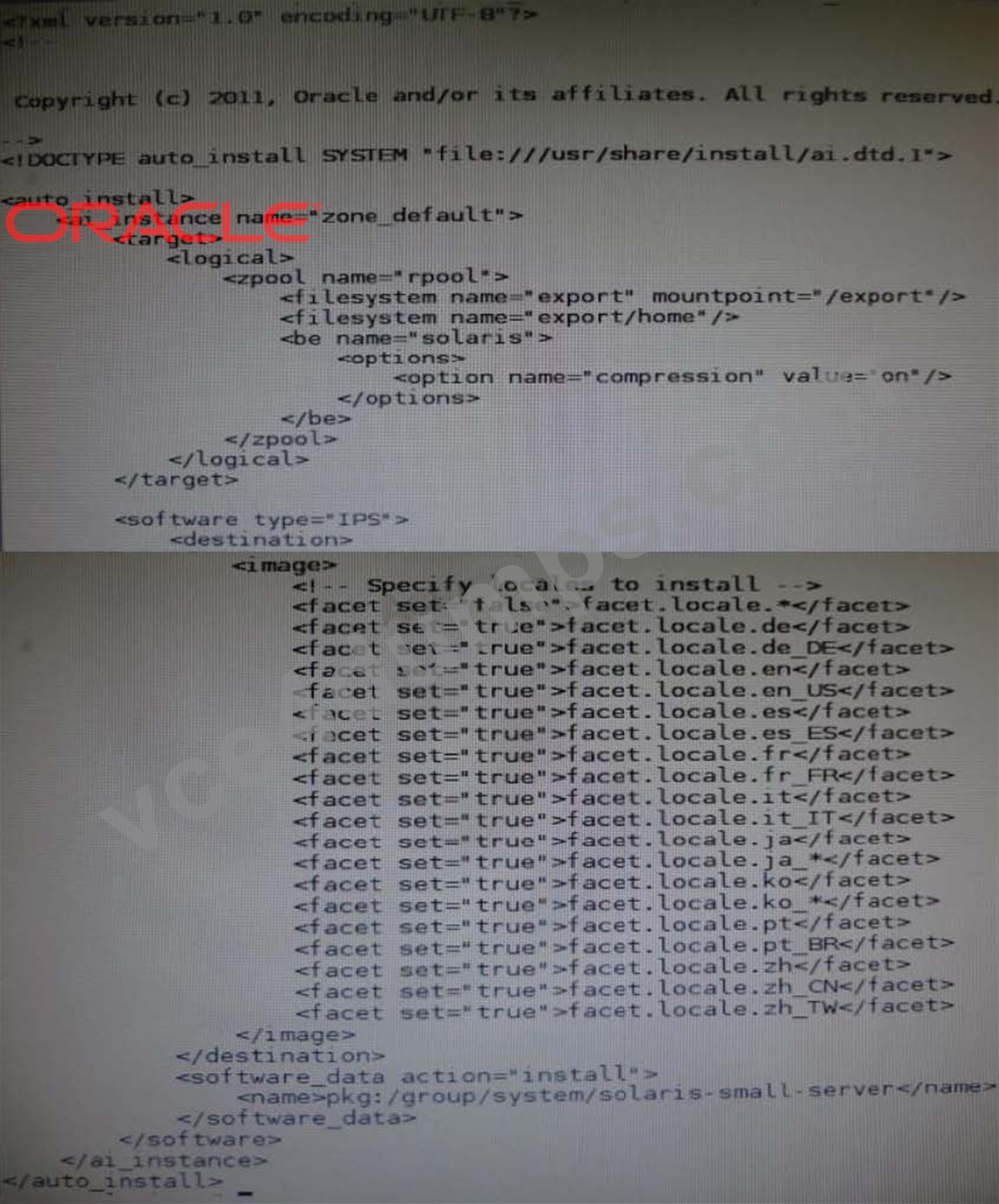
The file came from your Automated Installer (AI) install server.
The file is ____________.
- A. A custom AI manifest
- B. An AI SC profile for non-global zones
- C. The default AI conf ig file for non-global zones
- D. The default AI manifest for non-global zones
Answer: A
Explanation:
ai_manifest
-Automated installation manifest file format Synopsis /usr/share/install/ai.dtd.1
Some customizations have been made, such as the selection of specific locales.
Reference: Oracle Solaris 11 Installation Man Pages
NEW QUESTION # 31
You are troubleshooting the failure of a computer to mount an NFS file system hosted by a server (hostname mars) in the local area network.
Select the three commands that will enable you to identify the problem.
- A. cat /etc/vfstab
- B. showmount -e mars
- C. cat /etc/dfs/dfstab
- D. sharemgr show -v
- E. rpcinfo -s mars | egrep 'nfs|mountd'
- F. ping - s mars
Answer: A,B,E
Explanation:
Explanation/Reference:
Explanation:
B: The mount point Error. The following message appears during the boot process or in response toan explicit mount request and indicates a non-existent mount point.
Mount: mount-point /DS9 does not exist.
To solve the mount point error condition, check that the mount point exists on the client. Check the spelling of the mount point on the command line or in the /etc/vfstab file (B) on the client, or comment outthe entry and reboot the system.
Note: The /etc/vfstab file lists all the file systems to be automatically mounted at system boot time, with the exception of the /etc/mnttab and /var/run file systems.
E: showmount
This command displays all clients that have remotely mounted file systems that are shared from an NFS server, or only the file systems that are mounted by clients, or the shared file systems with the client access information. The command syntax is:
showmount [ -ade ] [ hostname ]
where -a prints a list of all the remote mounts (each entry includes the client name and the directory), -d prints a list of the directories that are remotely mounted by clients, -e prints a list of the files shared (or exported), and hostname selects the NFS server to gather the information from. If hostname is not specified the local host is queried.
F: * mountd Daemon
This daemon handles file-system mount requests from remote systems and provides access control. The mountd daemon checks /etc/dfs/sharetab to determine which file systems are available for remote mounting and which systems are allowed to do the remote mounting.
* Commands for Troubleshooting NFS Problems
These commands can be useful when troubleshooting NFS problems.
rpcinfo Command
This command generates information about the RPC service that is running on a system.
NEW QUESTION # 32
You are executing this command in the default shell:
sleep 5000 &
The system displays a number. This value is______.
- A. the process group ID that includes the /usr/bin/sleep process
- B. the priority of the /usr/bin/sleep process
- C. the process ID of the /usr/bin/sleep process
- D. the current number of instances of the /usr/bin/sleep process
- E. the process ID of the shell spawned to execute /usr/bin/sleep
- F. the amount of memory allocated to the /usr/bin/sleep process
Answer: E
Explanation:
If a command is terminated by the control operator '&', the shell executes the command asynchronously in a subshell. This is known as executing the command in the background.
The shell does not wait for the command to finish, and the return status is 0 (true).
NEW QUESTION # 33
You are setting up an automated installer (AI) install server and issue the following command:
installadm create-service -n prod_ai -s /repo/prod_ai.iso \
-i 192.168.1.100 -c 5 -d /export/repo
Which four options describe the install server that you have configured?
- A. DHCP base IP address is 192.168.1.100
- B. The service name is prod_ai.
- C. The initial IP address for the install clients will be 192.168.1.100. This IP address is temporary. After the client is booted, it will use IP addresses in the following range: 192.168.1.101-105.
- D. The AI net image ISO file is located in /repo/prod and the net image ISO will be unpacked in /export/ repo.
- E. Five IP addresses are allocated for DHCP clients, starting with 192.168.1.100.
- F. The Install server will support up to five clients.
- G. The AI net image ISO file is located in /repo/repo and is named /repo/prod/_ai.iso.
Answer: A,B,D,E
Explanation:
Explanation/Reference:
Explanation:
A: -n <svcname>
Uses this install service name instead of default
service name.
B: -i <dhcp_ip_start>
Sets up a new DHCP server. The IP addresses, starting from dhcp_address_start, are set up.
D: -c <count_of_ipaddr>
Sets up a total number of IP addresses in the DHCP table equal to the value of the count_of_ipaddr. The first IP address is the value of dhcp_ip_start that is provided by the -i option.
F: -s <srcimage>
Specifies location of AI ISO image to use for setting up the install service.
<targetdir>
Required: Specifies location to set up net image.
NEW QUESTION # 34
Select two correct statements about the authentication services available in Oracle Solaris
11.
- A. The Secure Shell can be configured to allow logins across a network to remote servers without transmitting passwords across the network.
- B. Simple Authentication and Security Layer (SASL) provides a mechanism to authenticate and encrypt access to local file system data.
- C. Pluggable Authentication Modules (PAM) is used to control the operation of services such console logins and ftp.
- D. Pluggable Authentication Modules (PAM) is used to implement the Secure Shell in Oracle Solaris 11.
- E. Secure Remote Procedure Calls (Secure RPC) provides a mechanism to encrypt data on any IP Socket connection.
Answer: B,C
Explanation:
A: Pluggable Authentication Modules (PAM) are an integral part of the authentication mechanism for the Solaris. PAM provides system administrators with the ability and flexibility to choose any authentication service available on a system to perform end-user authentication.
By using PAM,applications can perform authentication regardless of what authentication method is defined by the system administrator for the given client.
PAM enables system administrators to deploy the appropriate authentication mechanism for each service throughout the network. System administrators can also select one or multiple authentication technologies without modifying applications or utilities. PAM insulates application developers from evolutionary improvements to authentication technologies,while at the same time allowing deployed applications to use those improvements.
PAM employs run-time pluggable modules to provide authentication for system entry services.
E: The Simple Authentication and Security Layer (SASL) is a method for adding authentication support to connection-based protocols. Simple Authentication and Security Layer (SASL) is a framework for authentication and data security in Internet protocols. It decouples authentication mechanisms from application protocols,in theory allowing any authentication mechanism supported by SASL to be used in any application protocol that uses SASL. Authentication mechanisms can also support proxy authorization,a facility allowing one user to assume the identity of another. They can also provide a data security layer offering data integrity and data confidentiality services. DIGEST-MD5 provides an example of mechanisms which can provide a data-security layer. Application protocols that support SASL typically also support Transport Layer Security (TLS) to complement the services offered by SASL.
NEW QUESTION # 35
Which two are user definable OpenBoot parameters that can be set in the OpenBoot PROM?
- A. Powering off the hardware
- B. Host ID
- C. Default boot device
- D. IP address for the system console
- E. System date and time
- F. Verbose hardware diagnostics
Answer: C,F
Explanation:
Explanation/Reference:
Explanation:
The NVRAM chip stores user-definable system parameters, also referred to as NVRAM variables or EEPROM parameters. The parameters allow administrators to control variables such as the default boot device and boot command. The NVRAM also contains writeable areas for user-controlled diagnostics, macros, and device aliases. NVRAM is where the system identification information is stored, such as the host ID, Ethernet address, and time-of-day (TOD) clock.
Examples of NVRAM variables:
Variable Default Description boot-device disk or net
The device from which to start up.
diag-device net The diagnostic startup source device.
diag-file Empty string Arguments passed to the startup program in diagnostic mode.
diag-switch? false Whether to run in diagnostic mode
NEW QUESTION # 36
ServerA contains two ISO images of a package repository named so1.repo.iso-a and so1.repo.isob respectively. You need to create a single local package repository on server that clients can connect to. The package repository will be stored on the /export/IPS file system and named repo. The preferred publisher will be named solaris and the publisher URL will be http://serverA.example.com.
Which is the correct procedure to perform on ServerA to create the local Package repository?
- A. cat so1.repo.iso-a so1.repo.iso-b > so1.full.iso Mount the ISO image and use the rsync command to extract the contents of the ISO file to /export/IPS/repo Set the pkg/inst_root property to /export/IPS/repo and the pkg/readonly property to true Set the preferred publisher by using pkg set-publisher solaris \ -g http://pkg.oracle.com/
- B. cat so1.repo.iso-a so1.repo.iso-b > /export/IPS/repo Set the pkg/inst_root property to true and the pkg/readonly property to /export/IPS Set the preferred publisher by using pkg set-publisher -G http://serverA.example.com/ \ -g http://pkg/oracle.com/solaris/rekease/solaris
- C. cat so1.repo.iso-a sol.repo.iso-b > so1.full.iso Mount the ISO image and use the rsync command to extract the contents of the ISO file to the /export/IPS file system.
Set the pkg/inst_root property to /export/IPS/repo and the pkg/readonly property to true.
Set the preferred publisher by using pkg set-publisher -G
http://pkg.oracle.com/solaris/release/ \
-g http"//serverA.example.com/ solaris - D. cat so1.repo,iso-a so1.repo.iso-b > /export/IPS/repo.iso Mount the ISO image and copy the repo directory from the ISO image to /export/IPS/repo set the pkg/inst_root property and the pkg/readonly property to /export/IPS/repo set the preferred pkg/inst_root property by using pkg set-publisher - G http://serverA.example.com/ \
-g http://pkg.oracle.com/solaris.com/release/- p solaris
Answer: D
Explanation:
Concatenate the files into one file using the cat command.
Make the contents of the repository .iso file available using the mount command.
To increase the performance of repository accesses and to avoid the need to remount
the .iso image each time the system restarts, copy the repository files from /mnt/repo/to a ZFS file
system. You can do this copy with rsync or with tar.
Reference: Copying and Creating Oracle Solaris 11 Package Repositories, Copying a Repository
From a File
NEW QUESTION # 37
On server A, you enter the following command to add a static route to serverA route -p add -host
192.168.1.101 192.168.1.101 -static
What is the purpose of this command?
- A. to ensure the IP address for serverB is not flushed from the ARP cache
- B. to specify routing to an adjacent network when in.rdisc is not used
- C. to optimize link aggregation using a direct connection between two systems
- D. to specify an IPMP target IP address to in.mpathd
- E. to specify routing to an adjacent network when in.routed is not used
- F. to temporarily bypass IP Filter rules
Answer: D
Explanation:
Note: # route -p add -host destination-IP gateway-IP -static
where destination-IP and gateway-IP are IPv4 addresses of the host to be used as a target.
For example, you would type the following to specify the target system 192.168.10.137, which is on the same subnet as the interfaces in IPMP group itops0:
$ route -p add -host 192.168.10.137 192.168.10.137 -static This new route will be automatically configured every time the system is restarted. If you want to define only a temporary route to a target system for probe-based failure detection, then do not use the -p option.
NEW QUESTION # 38
In a fresh installation of Oracle Solaris 11, default datalinks are named with a genetic naming convention, and they increment as you add interfaces. What is the default name?
- A. nic#
- B. net#
- C. el000g#
- D. eth#
- E. lo#
Answer: B
Explanation:
When you install this Oracle Solaris release on a system for the first time, Oracle Solaris automatically provides generic link names for all the system's physical network devices.
This name assignment uses the net# naming convention, where the # is the instance number. This instance number increments for each device, for example, net0, net1, net2, and so on.
Note:
Network configuration in Oracle Solaris 11 includes
* Generic datalink name assignment - Generic names are automatically assigned to datalinks using the net0, net1, netN naming convention, depending on the total number of network devices that are on the system
NEW QUESTION # 39
Which option would you choose to display the kernel revision level for your operating system?
- A. pkg info kernel
- B. uname -a
- C. banner (issued from the OpenBoot Prom)
- D. cat. /etc/release
- E. cat /etc/motd
Answer: B
NEW QUESTION # 40
New features wore added to ZFS in Oracle Solaris11. Your justification to upgrade from Solaris10 to oracle Solaris11 is that it will be possible to take advantage of the enhancements that were made to ZFS.
Identify the three ZFS functions and features that are included in Oracle Solaris 11,but not in Solaris 10.
- A. elimination of the swap file system when using ZFS on the root disk
- B. Ability to use ZFS on the boot drive and boot to a ZFS root file system.
- C. Ability to split a mirrored ZFS storage pool
- D. Encrypted ZFS datasets
- E. Shadow Data Migration
- F. Ability for ZFS to detect and remove redundant data from the tile system
Answer: B,D,F
Explanation:
A: ZFS encryption was introduced in ZFS Pool Version Number 30,Solaris Nevada b149. Filesystem encryption since Solaris 11 Express
B: Deduplication was introduced in ZFS Pool Version Number 21,Solaris Nevada b128.
E: Booting From a ZFS Root File System Both SPARC based and x86 based systems use the new style of booting with a boot archive,which is a file system image that contains the files required for booting. When a system is booted from a ZFS root file system,the path names of both the boot archive and the kernel file are resolved in the root file system that is selected for booting.
NEW QUESTION # 41
You are installing the Solaris 11 Operation System by using the Text Installer. A panel prompts you to create a root password and a user account.
Which four describe your options for completing this panel of the Installation?
- A. The root password can be left blank.
- B. If you provide a username, that user is given root privileges.
- C. If you provide a username, root is an account rather than a role and is set to expire immediately.
- D. Creating a user account is optional.
- E. The root password must be set and cannot be blank.
- F. If you do not provide a username, root is an account rather than a role and is set to expire
immediately. - G. If you provide a username, that user is assigned the root role.
Answer: D,E,F,G
Explanation:
A: You are not required to create a user account.
B: You must create a root password.
D: If you create a user account in this panel, you need to provide both the user's password and a
root password.
In this case, root will be a role assigned to the user.
G: If you do not create a user account, you still need to provide a root password.
In this case, root will be a regular user.
Reference: Oracle Solaris 11 Information Library, Installing With the Text Installer, Complete the User panel.
NEW QUESTION # 42
dbzone is currently running on your server.
Which two methods would you use to safely and cleanly shut down dbzone and all of its applications?
- A. zlogin -z dbzone halt
- B. zoneadm -z dbzone shutdown -i0
- C. zlogin dbzone shutdown -i0
- D. zoneadm -z dbzone halt
- E. zoneadm -z dbzone shutdown
Answer: C,D
Explanation:
Explanation/Reference:
Explanation:
D: zoneadm halt command halts the specified zones. halt bypasses running the shutdown scripts inside the zone. It also removes run time resources of the zone.
E: Use: zlogin zone shutdown
to cleanly shutdown the zone by running the shutdown scripts.
Use this procedure to cleanly shut down a zone.
1. Become superuser, or assume the Primary Administrator role.
2. Log in to the zone to be shut down, for example, my-zone, and specify shutdown as the name of the utility and init 0 as the state global# zlogin my-zone shutdown -y -g0 -i 0
NEW QUESTION # 43
Examine this command and its output:
# zoneadm list
Global
zone2
Which two outcomes can be deduced from this output?
- A. There is one nonglobal zone that is not configured.
- B. The is one nonglobal zone that is not installed.
- C. There is one nonglobal zone that is not running.
- D. There is exactly one nonglobal zone configured.
- E. There is exactly one nonglobal zone installed.
- F. There is at least one oneglobal zone configured.
- G. There is one nonglobal zone running.
Answer: F,G
Explanation:
Explanation/Reference:
NEW QUESTION # 44
......
Get Latest 1Z0-821 Dumps Exam Questions: https://drive.google.com/open?id=1gin3TD2snztlL5-baDL8NaqrJyUzcnC6
Full 1Z0-821 Practice Test and 245 unique questions with explanations waiting just for you, get it now: https://www.vce4dumps.com/1Z0-821-valid-torrent.html