


[Aug 05, 2024] Get Latest and 100% Accurate CV0-004 Exam Questions
Maximum Grades By Making ready With CV0-004 Dumps
NEW QUESTION # 40
Between 11:00 a.m. and 1:00 p.m. on workdays, users report that the sales database is either not accessible, sluggish, or difficult to connect to. A cloud administrator discovers that during the impacted time, all hypervisors are at capacity. However, when 70% of the users are using the same database, those issues are not reported. Which of the following is the most likely cause?
- A. Sizing issues
- B. Oversubscription
- C. Service quotas
- D. Resource allocation
Answer: B
Explanation:
The most likely cause of accessibility and performance issues during specific times is oversubscription. This happens when more users are trying to access the database than the hypervisors can handle, due to their resources being allocated to more virtual machines or processes than they can efficiently support.
NEW QUESTION # 41
Which of the following is a direct effect of cloud migration on an enterprise?
- A. Compatibility issues must be addressed on premises after migration.
- B. Utility costs will be reduced on premises.
- C. Cloud solutions will require less resources than on-premises installations.
- D. The enterprise must reorganize the reporting structure.
Answer: B
Explanation:
Cloud migration typically results in a reduction of on-premises utility costs because the physical infrastructure requirements, such as power and cooling, are transferred to the cloud provider.
This shift can lead to significant savings in utility expenses for the enterprise.
NEW QUESTION # 42
Which of the following network types allows the addition of new features through the use of network function virtualization?
- A. Local area network
- B. Wide area network
- C. Storage area network
- D. Software-defined network
Answer: D
Explanation:
A Software-Defined Network (SDN) is a network approach that allows the addition of new features through software configurations rather than hardware updates, making use of network function virtualization (NFV). NFV decouples network functions from proprietary hardware appliances, so they can run in software, which aligns with the flexibility offered by SDN. Reference: CompTIA Cloud+ Study Guide (Exam CV0-004) - Chapter on Network Management
NEW QUESTION # 43
A company has one cloud-based web server that is prone to downtime during maintenance. Which ot the following should the cloud engineer add to ensure high availability?
- A. An autoscaling feature on the web server
- B. A secondary network link to the web server
- C. A backup cloud web server
- D. A redundant web server behind a load balancer
Answer: D
Explanation:
Adding a redundant web server behind a load balancer is the solution that will ensure high availability. If one server goes down for maintenance, the other can take over, ensuring that the web service remains available without interruption.
Reference: High availability concepts, including the use of load balancers and redundant servers, are part of cloud infrastructure design as per CompTIA Cloud+.
NEW QUESTION # 44
A cloud architect is reviewing the design for a new cloud-based ERP solution. The solution consists of eight servers with a single network interface. The allocated IP range is 172.16.0.0/28.
One of the requirements of the solution is that it must be able to handle the potential addition of
16 new servers to the environment. Because of the complexity of the firewall and related ACL requirements, these new servers will need to be in the same network range. Which of the following changes would allow for the potential server addition?
- A. Change the subnet mask to use a 255.255.255.128 range.
- B. Change the server template to add network interfaces.
- C. Change the IP address range to use a 10.0.0.0 address.
- D. Change the server scaling configuration to increase the maximum limit.
Answer: A
Explanation:
The current IP address range, 172.16.0.0/28, can only accommodate 14 hosts. To accommodate
16 new servers, the subnet mask needs to be changed to 255.255.255.128, which will allow for
16 hosts per subnet.
NEW QUESTION # 45
An administrator used a script that worked in the past to create and tag five virtual machines. All of the virtual machines have been created: however, the administrator sees the following results:
{ tags: [ ] }
Which of the following is the most likely reason for this result?
- A. Service quotas
- B. Command deprecation
- C. API throttling
- D. Compatibility issues
Answer: B
Explanation:
The most likely reason for the script creating virtual machines without tags, despite working in the past, is command deprecation. Cloud service providers update their APIs and CLI commands over time, and a previously used command to tag resources might no longer be valid.
Reference: Understanding cloud service APIs and the importance of keeping up with updates is part of cloud technical operations covered in CompTIA Cloud+.
NEW QUESTION # 46
An e-commerce company is migrating from an on-premises private cloud environment to a public cloud IaaS environment. You are tasked with right-sizing the environment to save costs after the migration. The company's requirements are to provide a 20% overhead above the average resource consumption, rounded up.
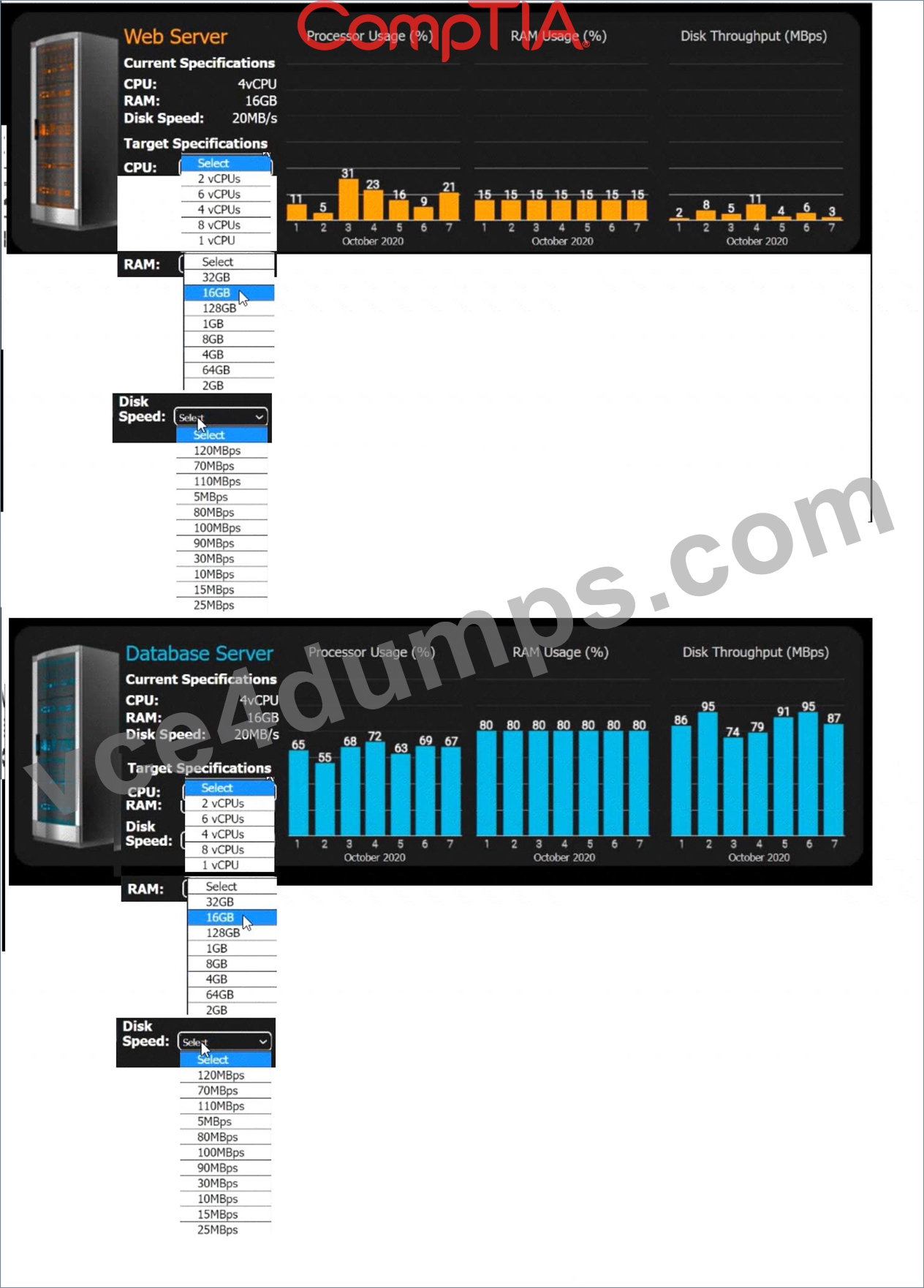
INSTRUCTIONS
Review the specifications and graphs showing resource usage for the web and database servers. Determine the average resource usage and select the correct specifications from the available drop-down options.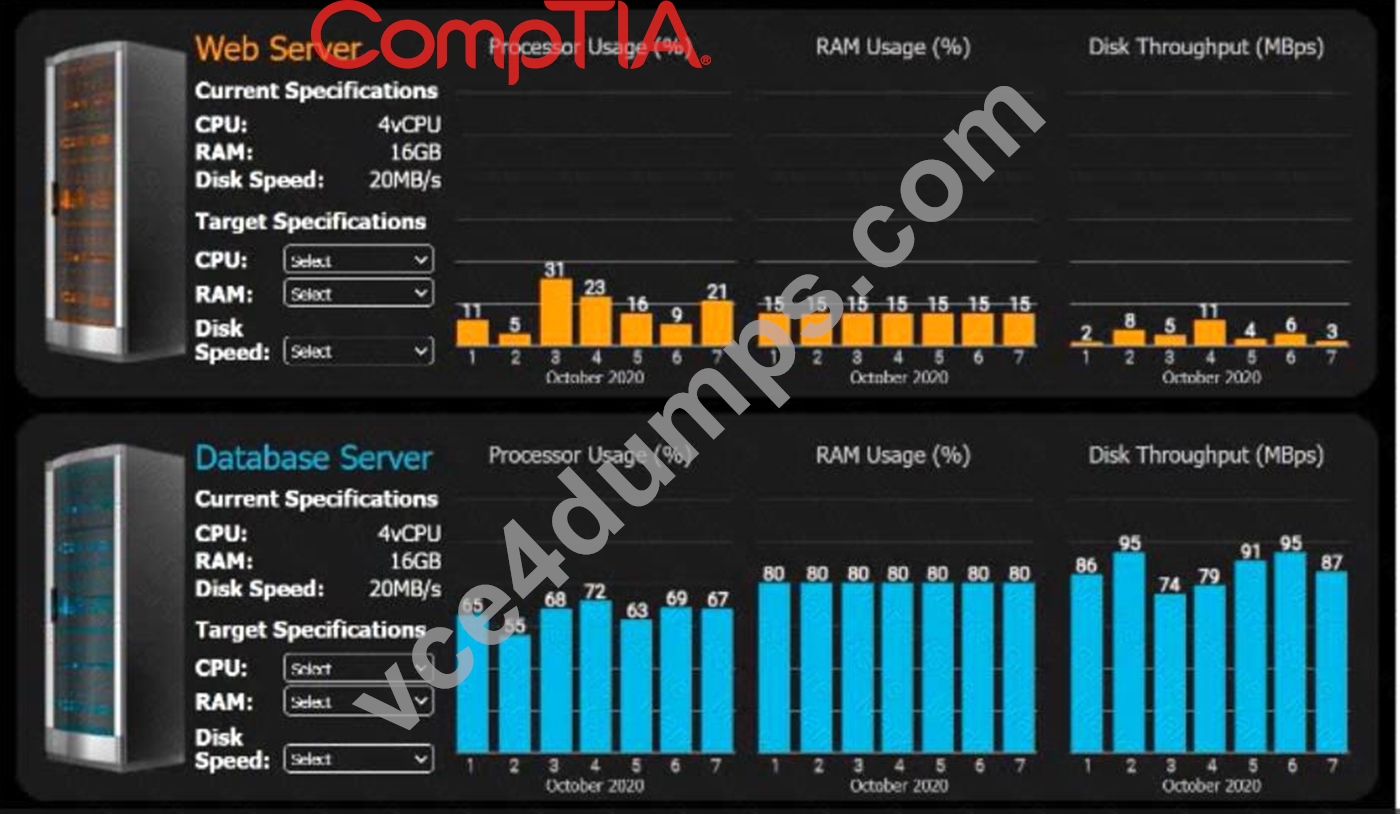
Answer:
Explanation: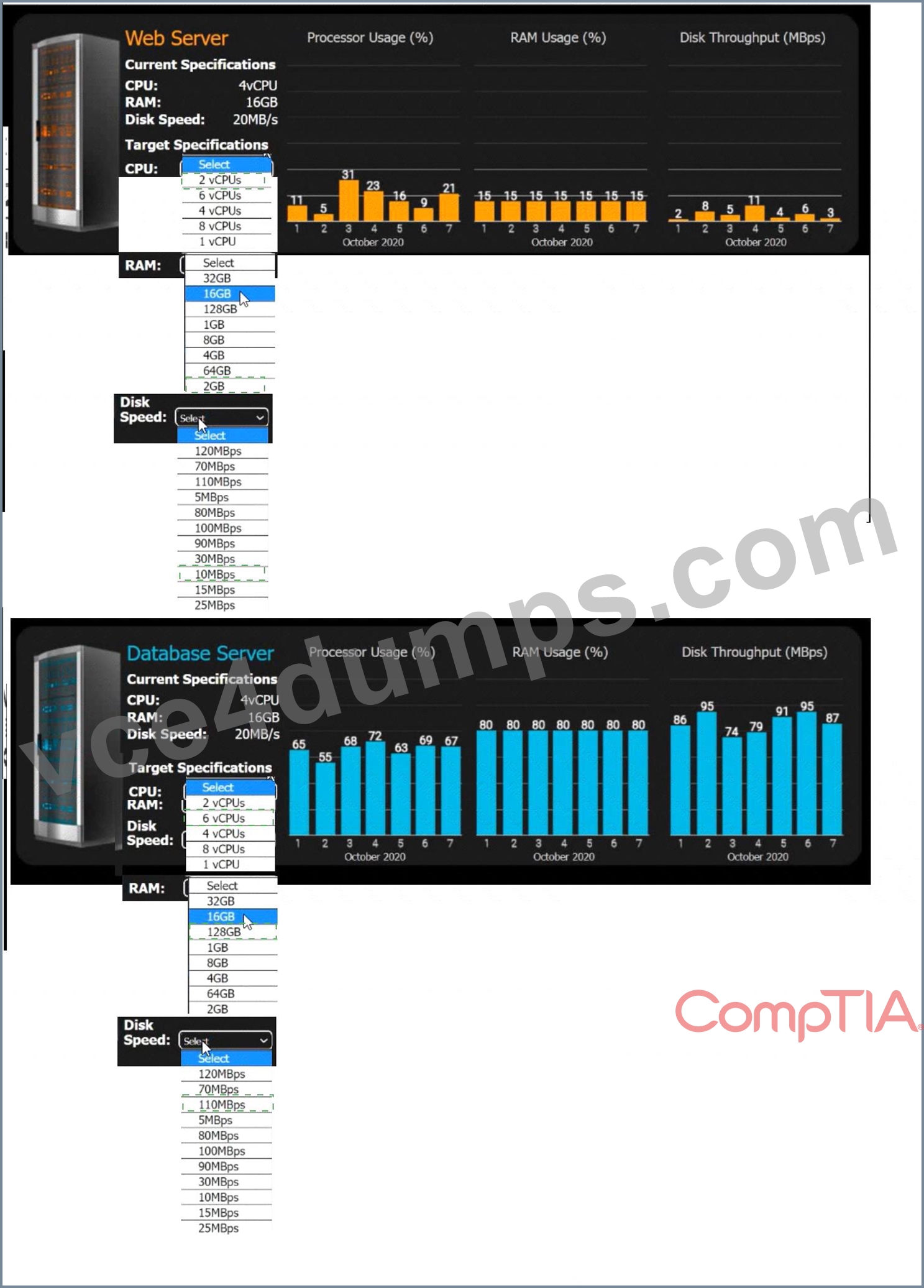
Explanation:
For the Web Server:
* CPU: 2 vCPUs
* RAM: 2GB
* Disk Speed: 10MBps
For the Database Server:
* CPU: 6 vCPUs
* RAM: 128GB
* Disk Speed: 110MBps
These selections are based on maintaining a 20% overhead above the average resource consumption and rounding up to the next available option in the dropdowns provided.
NEW QUESTION # 47
Which of the following strategies requires the development of new code before an application can be successfully migrated to a cloud provider?
- A. Rehost
- B. Rearchitect
- C. Refactor
- D. Replatform
Answer: C
Explanation:
Refactoring requires the development of new code before an application can be successfully migrated to a cloud provider. It often involves restructuring and optimizing the existing code without changing its external behavior to fit into the new cloud environment.References: Application migration strategies and the requirements for each, like refactoring, are included in cloud migration best practices covered in CompTIA Cloud+.
NEW QUESTION # 48
A company experienced a data leak through its website. A security engineer, who is investigating the issue, runs a vulnerability scan against the website and receives the following output: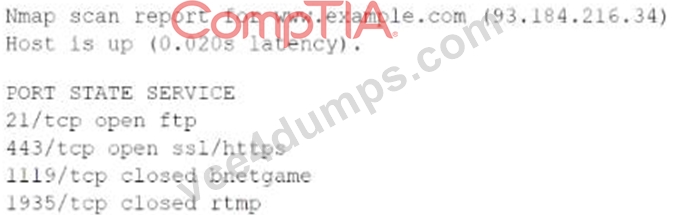
Which of the following is the most likely cause of this leak?
- A. RTMP port open
- B. Privilege escalation
- C. Insecure protocol
- D. SQL injection
Answer: C
Explanation:
The data leak is most likely caused by the use of an insecure protocol. The vulnerability scan output shows that port 21/tcp for FTP (File Transfer Protocol) is open. FTP is known for transmitting data unencrypted, which could allow sensitive data to be intercepted during transfer.References: The security risks associated with the use of insecure or unencrypted protocols are covered under cloud security best practices in the CompTIA Cloud+ curriculum.
NEW QUESTION # 49
A social networking company operates globally. Some users from Brazil and Argentina are reporting the following error: website address was not found. Which of the following is the most likely cause of this outage?
- A. DNS propagation issues
- B. DNS server misconfiguration
- C. Regional DNS provider outage
- D. Client DNS misconfigutation
Answer: C
Explanation:
The most likely cause of the outage, with users from specific regions like Brazil and Argentina reporting an error that the website address was not found, is a regional DNS provider outage. This type of outage would affect users in particular areas, preventing domain name resolution and leading to the reported error.
Reference: Regional outages and their impact on service availability are discussed within the Cloud Concepts domain, which includes understanding the importance of DNS in cloud services, as per the CompTIA Cloud+ objectives.
NEW QUESTION # 50
A company has decided to scale its e-commerce application from its corporate datacenter to a commercial cloud provider to meet an anticipated increase in demand during an upcoming holiday.
The majority of the application load takes place on the application server under normal conditions. For this reason, the company decides to deploy additional application servers into a commercial cloud provider using the on-premises orchestration engine that installs and configures common software and network configurations.
The remote computing environment is connected to the on-premises datacenter via a site-to-site IPSec tunnel.
The external DNS provider has been configured to use weighted round-robin routing to load balance connections from the Internet.
During testing, the company discovers that only 20% of connections completed successfully.
INSTRUCTIONS
Review the network architecture and supporting documents and fulfill these requirements:
Part 1:
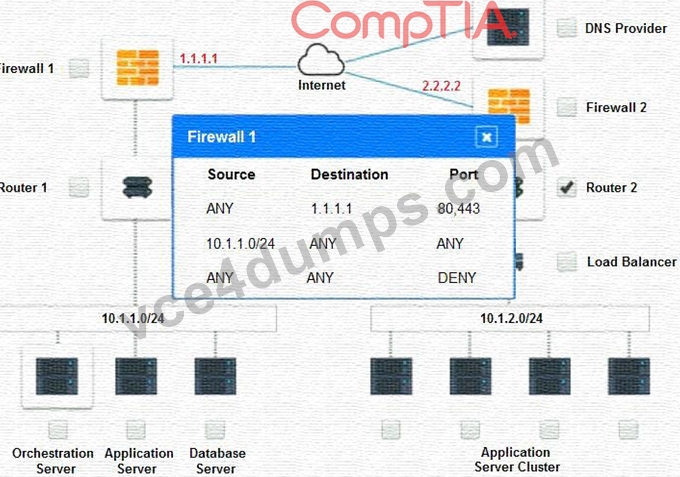
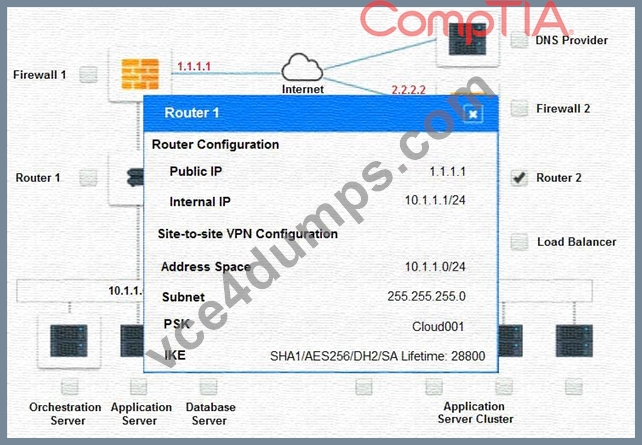
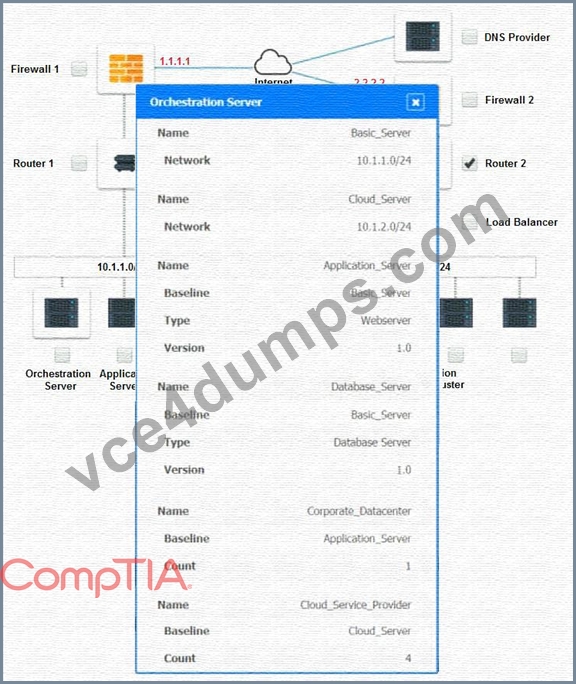
Analyze the configuration of the following components: DNS, Firewall 1, Firewall 2, Router 1, Router 2, VPN and Orchestrator Server.
Identify the problematic device(s).
Part 2:
Identify the correct options to provide adequate configuration for hybrid cloud architecture.
If at any time you would like to bring back the initial state of the simulation, please click the Reset All button.
Part 1:
Cloud Hybrid Network Diagram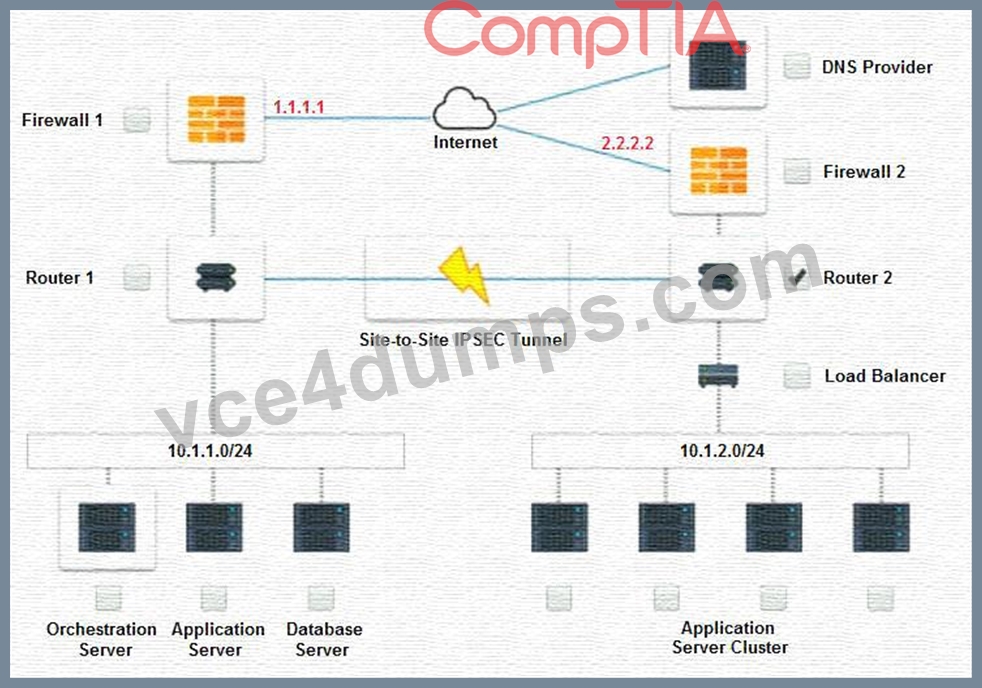
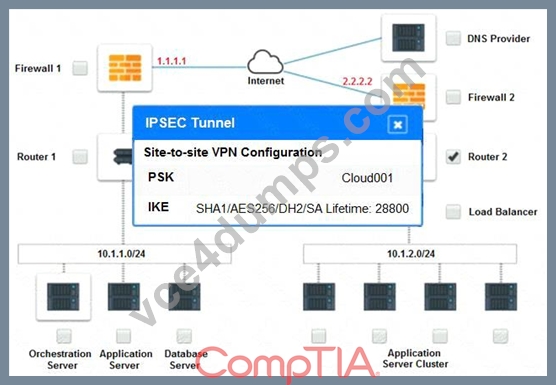
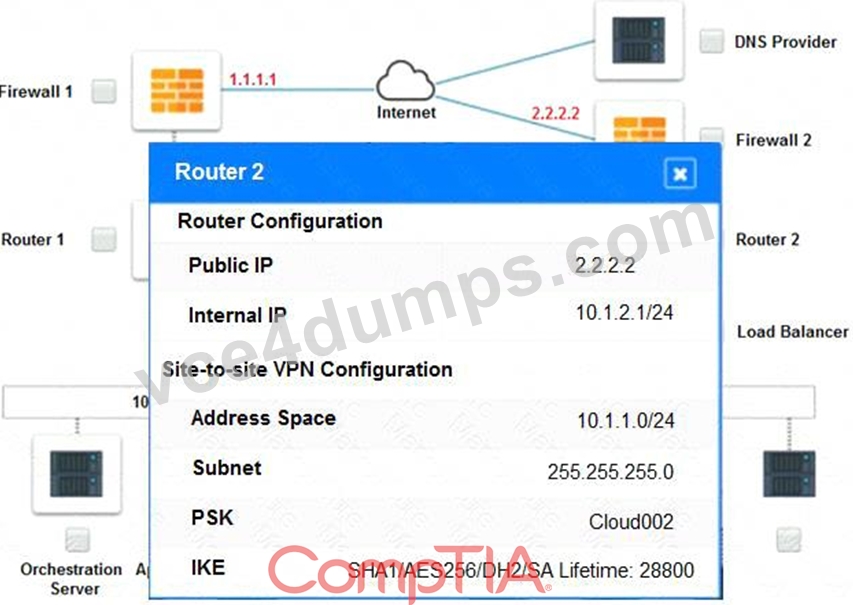
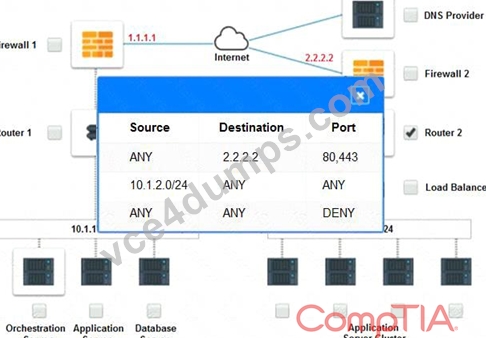
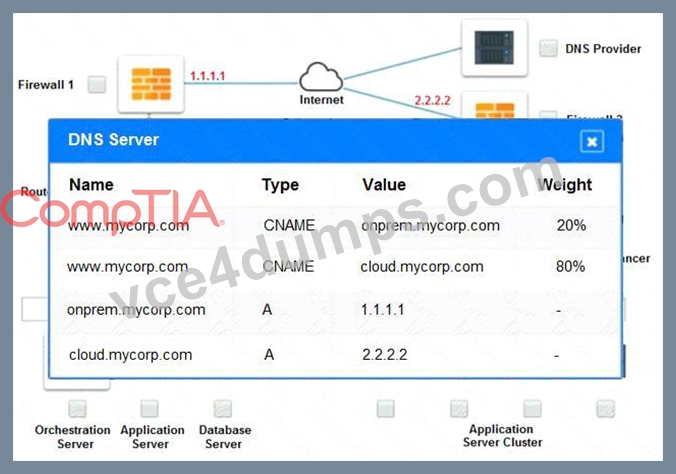
Part 2:
Only select a maximum of TWO options from the multiple choice question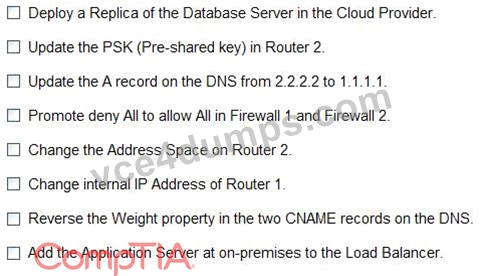
Answer:
Explanation:
See explanation below.
Explanation:
Part 1: Router 2
The problematic device is Router 2, which has an incorrect configuration for the IPSec tunnel. The IPSec tunnel is a secure connection between the on-premises datacenter and the cloud provider, which allows the traffic to flow between the two networks. The IPSec tunnel requires both endpoints to have matching parameters, such as the IP addresses, the pre-shared key (PSK), the encryption and authentication algorithms, and the security associations (SAs) .
According to the network diagram and the configuration files, Router 2 has a different PSK and a different address space than Router 1. Router 2 has a PSK of "1234567890", while Router 1 has a PSK of
"0987654321". Router 2 has an address space of 10.0.0.0/8, while Router 1 has an address space of
192.168.0.0/16. These mismatches prevent the IPSec tunnel from establishing and encrypting the traffic between the two networks.
The other devices do not have any obvious errors in their configuration. The DNS provider has two CNAME records that point to the application servers in the cloud provider, with different weights to balance the load.
The firewall rules allow the traffic from and to the application servers on port 80 and port 443, as well as the traffic from and to the VPN server on port 500 and port 4500. The orchestration server has a script that installs and configures the application servers in the cloud provider, using the DHCP server to assign IP addresses.
Part 2:
The correct options to provide adequate configuration for hybrid cloud architecture are:
* Update the PSK in Router 2.
* Change the address space on Router 2.
These options will fix the IPSec tunnel configuration and allow the traffic to flow between the on-premises datacenter and the cloud provider. The PSK should match the one on Router 1, which is "0987654321". The address space should also match the one on Router 1, which is 192.168.0.0/16.
B. Update the PSK (Pre-shared key in Router2)
E. Change the Address Space on Router2
NEW QUESTION # 51
Given the following command:
Sdocker pull images.comptia.org/user1/myimage:latest
Which of the following correctly identifies images.comptia.org?
- A. Image version
- B. Image registry
- C. Image name
- D. Image creator
Answer: B
Explanation:
In the Docker pull command given, images.comptia.org represents the image registry. A Docker image registry is a collection of repositories that host Docker images. It is where images are stored and organized, and from where they can be pulled for deployment.
NEW QUESTION # 52
An IT manager needs to deploy a cloud solution that meets the following requirements:
. Users must use two authentication methods to access resources.
* Each user must have 10GB of storage space by default.
Which of the following combinations should the manager use to provision these requirements?
- A. OAuth 2.0 and ephemeral storage
- B. MFA and storage quotas
- C. SSO and external storage
- D. OIDC and persistent storage
Answer: B
Explanation:
The combination that should be used to provision the requirements of two authentication methods and 10GB of storage space by default for each user is Multi-Factor Authentication (MFA) and storage quotas. MFA provides an additional layer of security beyond just a username and password, and storage quotas can be used to allocate a specific amount of storage space for each user. Reference: CompTIA Cloud+ Study Guide (Exam CV0-004) by Todd Montgomery and Stephen Olson
NEW QUESTION # 53
A company uses containers stored in Docker Hub to deploy workloads (or its laaS infrastructure.
The development team releases changes to the containers several times per hour. Which of the following should a cloud engineer do to prevent the proprietary code from being exposed to third parties?
- A. Deploy the containers over SSH.
- B. Convert the containers to VMs.
- C. Use private repositories for the containers.
- D. Use laC to deploy the laaS infrastructure.
Answer: C
Explanation:
To prevent proprietary code from being exposed to third parties, a cloud engineer should use private repositories for the containers. Private repositories ensure that access to container images is restricted and controlled, unlike public repositories where images are accessible to anyone.
NEW QUESTION # 54
An IT manager is migrating the production environment to the cloud but needs to keep control of the operating systems, patches, and settings of all resources. Which of the following deployment models will best meet the requirements?
- A. FaaS
- B. SaaS
- C. laaS
- D. PaaS
Answer: C
Explanation:
Infrastructure as a Service (IaaS) is the deployment model that will best meet the requirements of retaining control over the operating systems, patches, and settings of all resources. IaaS provides the cloud infrastructure but leaves the management of the operating system and applications to the user.References: The cloud service models and the level of control they offer are fundamental topics in the CompTIA Cloud+ certification material.
NEW QUESTION # 55
A customer is migrating applications to the cloud and wants to grant authorization based on the classification levels of each system. Which of the following should the customer implement to ensure authorisation to systems is granted when the user and system classification properties match? (Choose two.)
- A. Token-based authentication
- B. Bastion host
- C. Resource tagging
- D. Discretionary access control
- E. Multifactor authentication
- F. Role-based access control
Answer: D,F
Explanation:
Discretionary Access Control (DAC) and Role-Based Access Control (RBAC) are effective methods for granting authorization based on system classification levels. DAC allows resource owners to grant access rights, making it flexible for environments with varying classification levels. RBAC assigns permissions based on roles within an organization, aligning access rights with the user's job functions and ensuring that users access only what is necessary for their role, which can be mapped to system classifications.
NEW QUESTION # 56
Which of the following can reduce the risk of CI/CD pipelines leaking secrets?
- A. Protected Git branches
- B. Use of a VM instead of containers
- C. Canary tests
- D. Private image repositories
Answer: A
Explanation:
Protected Git branches help reduce the risk of CI/CD pipelines leaking secrets by imposing restrictions on who can commit to the branches, enforce status checks before merging, and prevent unauthorized access or changes to sensitive information, such as API keys, passwords, and secret tokens. This ensures that only approved changes can be made to the codebase, and sensitive information is safeguarded.
NEW QUESTION # 57
A company implements a web farm with 100 servers behind an application load balancer. Dunng scaling events, new web servers that are placed in service have not loaded all their modules, which causes some requests to the web farm to fail. Which of the following should the cloud engineer implement to address the scaling issue?
- A. Instance warm-up
- B. Load balancer passthrough
- C. Scheduled scaling
- D. Event-based scaling
Answer: A
Explanation:
Implementing an instance warm-up period can address the issue of new web servers not having all modules loaded during scaling events. This warm-up period allows new instances to fully initialize and start serving traffic only when they are ready, preventing failed requests.
Reference: Scaling strategies and their operational impact, including the concept of instance warm-up, are covered under cloud infrastructure management in the CompTIA Cloud+ curriculum.
NEW QUESTION # 58
A cloud administrator needs to collect process-level, memory-usage tracking for the virtual machines that are part of an autoscaling group. Which of the following is the best way to accomplish the goal by using cloud-native monitoring services?
- A. Deploying the cloud-monitoring agent software
- B. Enabling memory monitoring in the VM configuration
- C. Configuring page file/swap metrics
- D. Scheduling a script to collect the data
Answer: A
Explanation:
To collect process-level, memory-usage tracking for virtual machines, deploying cloud-monitoring agent software is the best approach. The agent can gather detailed system metrics and send them to the cloud-native monitoring services for analysis and visualization.
NEW QUESTION # 59
......
Give push to your success with CV0-004 exam questions: https://www.vce4dumps.com/CV0-004-valid-torrent.html
Prepare CV0-004 Exam Questions Recently Updated Questions: https://drive.google.com/open?id=1NxPKlMIXgcksxYv9_y1jE4yLMpSGnYHQ