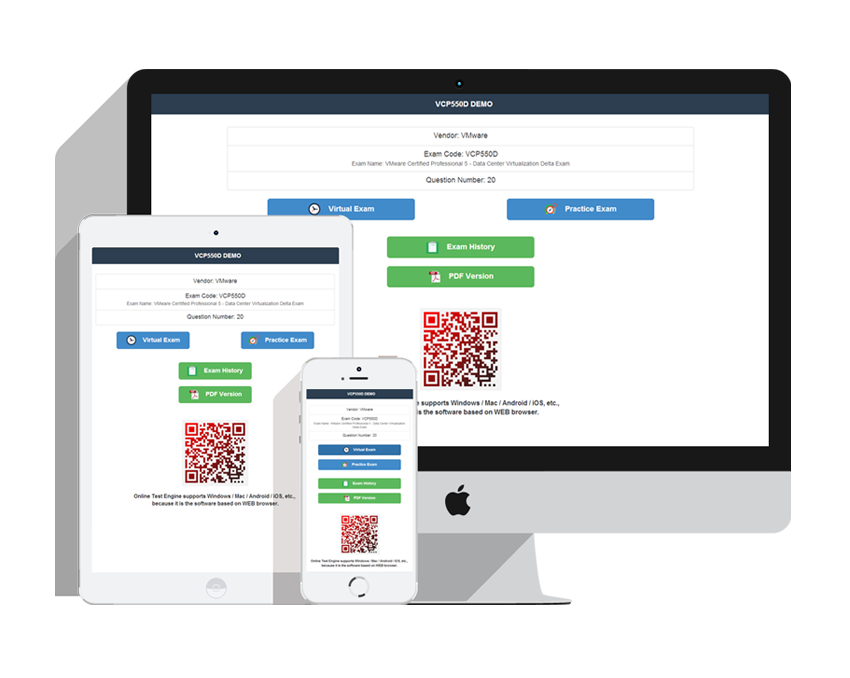
Free Demo


The service of VCE4Dumps
First, you can download the trial of Professional-Machine-Learning-Engineer free vce before you buy.
Second, you will be allowed to free updating the Professional-Machine-Learning-Engineer exam dumps vce one-year after you become a member of us.
Third, we offer 24/7 customer assisting to support if you have any problems about the downloading or purchasing the Professional-Machine-Learning-Engineer vce dumps.
Forth, we adhere to the principle of No help, Full refund. The money will be full refund if you got a bad result with our Professional-Machine-Learning-Engineer test dumps.
Do you want to enter into the big international companies? Do you want to meet influential people and extraordinary people of IT field? Do you want to make some achievements in your career? Getting the Professional-Machine-Learning-Engineer certification may be the first step for you. As the major exam of Google, Google are recognized by most companies and it proves your IT ability. But the problem is how to get Google certification quickly. It will be twice as much as can be accomplished with half of effort with a good helper. VCE4Dumps will be a good helper in the course of preparing your Professional-Machine-Learning-Engineer test dumps. You just need to spend your spare time to practice the Professional-Machine-Learning-Engineer vce files and Professional-Machine-Learning-Engineer test dumps, the test wll be easy for you.

Why you choose VCE4Dumps
First, it is professional. Professional-Machine-Learning-Engineer exam dumps vce and Professional-Machine-Learning-Engineer dumps pdf are created by our IT workers who are specialized in the study of real Professional-Machine-Learning-Engineer test dumps for many years and they check the updating of Professional-Machine-Learning-Engineer vce dumps everyday to make sure the valid of Professional-Machine-Learning-Engineer dumps latest, so you can rest assure of the accuracy of our Professional-Machine-Learning-Engineer vce dumps. The Professional-Machine-Learning-Engineer vce files of our VCE4Dumps contain questions and correct answers and detailed answer explanations and analysis, which apply to any level of candidates. You will pass the test with high rate If you practice the Professional-Machine-Learning-Engineer dumps latest seriously and skillfully.
Second, the pass rate is high. May be you are still wonder how to choose, we can show you the date of our pass rate in recent years. The Professional-Machine-Learning-Engineer exam dumps vce helped more than 100000+ candidates to get the certification and the pass rate is up to 79%. Many customers of VCE4Dumps reflected that our Professional-Machine-Learning-Engineer vce dumps have 80% similarity to the real Professional-Machine-Learning-Engineer test dumps. So if you prepare the Professional-Machine-Learning-Engineer dumps pdf and Professional-Machine-Learning-Engineer dumps latest seriously and remember the key points of Professional-Machine-Learning-Engineer test dumps, your pass rate will reach to 80%. So you need to pay much attention to the Professional-Machine-Learning-Engineer exam dumps vce before test.
Third, it is convenient. Online test engine is only service you can enjoy from our website. It is a simulation of formal test and you can feel the atmosphere of real test. What's more, it allows you to practice the Professional-Machine-Learning-Engineer dumps pdf in any electronic equipments. If you open it with internet, you can do the Professional-Machine-Learning-Engineer vce files anywhere. When you are waiting people or taking a bus, you can remember or practice the Professional-Machine-Learning-Engineer vce files without any limitation.
Difficulty in Writing Professional Machine Learning Engineer - Google
This exam may go hard for you if you had not done its preparation properly. There are many websites that are offering the latest Google Machine Learning Professional questions and answers but these questions are not verified by Google certified experts and that's why many are failed in their just first attempt. VCE4Dumps is the best platform which provides the candidate with the necessary Google Machine Learning Professional exam questions that will help him to pass the Google Machine Learning Professional on the first time. Candidate will not have to take the Google Machine Learning Professional twice because with the help of Google Professional-Machine-Learning-Engineer exam dumps candidate will have every valuable material required to pass the Google Machine Learning Professional. We are providing the latest and actual questions and that is the reason why this is the one that he needs to use and there are no chances to fail when a candidate will have valid exam dumps from VCE4Dumps. We have the guarantee that the questions that we have will be the ones that will pass candidate in the Google Machine Learning Professional in the very first attempt.
The aim is to keep candidates up-to-date and we shall automatically amend the material when and when the Offensive Protection reports any changes in the Google Professional-Machine-Learning-Engineer exam dumps.
Understanding functional and technical aspects of Professional Machine Learning Engineer - Google ML Problem Framing
The following will be discussed in Google Professional-Machine-Learning-Engineer exam dumps:
- Aligning with Google AI principles and practices (e.g. different biases)
- Define business success criteria
- Key results
- Determination of when a model is deemed unsuccessful
- Assessing data readiness
- Defining outcome of model predictions
- Identify risks to feasibility and implementation of ML solution. Considerations include:
- Identifying data sources
- Defining business problems
- Identifying nonML solutions
- Defining output use
- Define ML problem
- Managing incorrect results
- Defining problem type (classification, regression, clustering, etc.)
- Defining the input (features) and predicted output format
- Success metrics
- Assessing and communicating business impact
- Assessing ML solution readiness
Reference: https://cloud.google.com/certification/guides/machine-learning-engineer
Google Professional-Machine-Learning-Engineer Exam Syllabus Topics:
| Section | Objectives |
|---|---|
| Scaling prototypes into ML models | - Training at scale (Distributed training, TPUs) - Hyperparameter tuning - Frameworks (TensorFlow, PyTorch, JAX, Scikit-learn) |
| Monitoring ML solutions | - Performance monitoring and drift detection - Logging and alerting (Cloud Monitoring) - Model retraining strategies |
| Serving and scaling models | - Model optimization (Quantization, Distillation) - Online prediction (Vertex AI Prediction) - Hardware accelerators (GPU/TPU) in serving - Batch prediction |
| Architecting low-code ML solutions | - Implementing BigQuery ML for basic models - AutoML capabilities and implementation - Leveraging pre-built ML models as a service (e.g., Vision AI, Speech-to-Text, Recommendations AI) |
| Collaborating within and across teams to manage data and models | - Collaboration between Data Scientists, Data Engineers, and ML Engineers - Version control and reproducibility (e.g., DVC, MLOps) - Data management and governance |
| Automating and orchestrating ML pipelines | - Triggering and scheduling pipelines - CI/CD for ML systems - Vertex AI Pipelines (Kubeflow Pipelines) |
Google Professional Machine Learning Engineer Sample Questions:
You have a custom job that runs on Vertex AI on a weekly basis. The job is implemented using a proprietary ML workflow that produces the datasets, models, and custom artifacts, and sends them to a Cloud Storage bucket. Many different versions of the datasets and models were created. Due to compliance requirements, your company needs to track which model was used for making a particular prediction, and needs access to the artifacts for each model. How should you configure your workflows to meet these requirements?
- A. Use the Vertex AI Metadata API inside the custom job to create context, execution, and artifacts for each model, and use events to link them together.
- B. Register each model in Vertex AI Model Registry, and use model labels to store the related dataset and model information.
- C. Create a Vertex AI experiment, and enable autologging inside the custom job.
- D. Configure a TensorFlow Extended (TFX) ML Metadata database, and use the ML Metadata API.
Correct Answer: A 🗳️
You are working on a prototype of a text classification model in a managed Vertex AI Workbench notebook. You want to quickly experiment with tokenizing text by using a Natural Language Toolkit (NLTK) library. How should you add the library to your Jupyter kernel?
- A. Create a new Vertex AI Workbench notebook with a custom image that includes the NLTK library.
- B. Install the NLTK library from a Jupyter cell by using the !pip install nltk --user command.
- C. Write a custom Dataflow job that uses NLTK to tokenize your text and saves the output to Cloud Storage.
- D. Install the NLTK library from a terminal by using the pip install nltk command.
Correct Answer: B 🗳️
You recently joined a machine learning team that will soon release a new project. As a lead on the project, you are asked to determine the production readiness of the ML components. The team has already tested features and data, model development, and infrastructure. Which additional readiness check should you recommend to the team?
- A. Ensure that all hyperparameters are tuned.
- B. Ensure that feature expectations are captured in the schema.
- C. Ensure that model performance is monitored.
- D. Ensure that training is reproducible.
Correct Answer: C 🗳️
Explanation: Only visible for VCE4Dumps members. You can sign-up / login (it's free).
You work at a bank. You need to develop a credit risk model to support loan application decisions. You decide to implement the model by using a neural network in TensorFlow. Due to regulatory requirements, you need to be able to explain the model's predictions based on its features. When the model is deployed, you also want to monitor the model's performance over time. You decided to use Vertex AI for both model development and deployment. What should you do?
- A. Use Vertex Explainable AI with the sampled Shapley method, and enable Vertex AI Model Monitoring to check for feature distribution skew.
- B. Use Vertex Explainable AI with the XRAI method, and enable Vertex AI Model Monitoring to check for feature distribution drift.
- C. Use Vertex Explainable AI with the sampled Shapley method, and enable Vertex AI Model Monitoring to check for feature distribution drift.
- D. Use Vertex Explainable AI with the XRAI method, and enable Vertex AI Model Monitoring to check for feature distribution skew.
Correct Answer: C 🗳️
You work for a large bank that serves customers through an application hosted in Google Cloud that is running in the US and Singapore. You have developed a PyTorch model to classify transactions as potentially fraudulent or not. The model is a three-layer perceptron that uses both numerical and categorical features as input, and hashing happens within the model.
You deployed the model to the us-central1 region on nl-highcpu-16 machines, and predictions are served in real time. The model's current median response latency is 40 ms. You want to reduce latency, especially in Singapore, where some customers are experiencing the longest delays.
What should you do?
- A. Change the machines being used for online inference to nl-highcpu-32.
- B. Deploy the model to Vertex AI private endpoints in the us-central1 and asia-southeast1 regions, and allow the application to choose the appropriate endpoint.
- C. Create another Vertex AI endpoint in the asia-southeast1 region, and allow the application to choose the appropriate endpoint.
- D. Attach an NVIDIA T4 GPU to the machines being used for online inference.
Correct Answer: C 🗳️
Explanation: Only visible for VCE4Dumps members. You can sign-up / login (it's free).
Viewing page 1 out of 83 pages.
Viewing questions 1-5 out of 412 questions.