


Quickly and Easily Pass HP Exam with HPE6-A86 real Dumps Updated on Apr-2026
Realistic HPE6-A86 Dumps Questions To Gain Brilliant Result
NEW QUESTION # 18
A Network Operator has just configured a new LACP-based Link Aggregation Group (LAG) between an access switch and a core switch. The LAG, `lag 1`, is composed of ports 1/1/47 and
1/1/48. The operator needs to validate that both physical links have successfully joined the aggregation and that LACP negotiation is complete.
The operator needs to answer the following questions:
* Is LACP enabled on the LAG?
* Are both member ports (1/1/47 and 1/1/48) successfully bundled?
* What is the operational state of the local and partner ports?
Which of the following validation commands provides the most direct and detailed output to answer all these questions?
- A. `show interface lag 1`
- B. `show lacp interfaces`
- C. `show mac-address-table interface lag 1`
- D. `show running-config interface lag 1`
Answer: B
NEW QUESTION # 19
What does the acronym AAA stand for?
- A. Authentication, Authorization, and Accounting
- B. Aruba Authentication Algorithm
- C. Authorization, Accessibility and Accountability
- D. Access Acceptance Attributes
Answer: A
Explanation:
AAA stands for Authentication, Authorization, and Accounting, which together define the framework used to verify user identities, control access to network resources, and log user activities.
NEW QUESTION # 20
Which of the statements is true about Rapid Spanning Tree Protocol (RSTP)? (Select two)
- A. It supports only a single spanning tree instance.
- B. It uses the same port roles and states as STP.
- C. It operates on a per-VLAN basis.
- D. It has a faster convergence time than STP.
Answer: A,D
NEW QUESTION # 21
A Network Technician is configuring a Switched Virtual Interface (SVI) for VLAN 10 to act as the default gateway for that subnet. The desired IP address is 192.168.10.1 with a subnet mask of
255.255.255.0.
Which command sequence correctly configures this SVI?
- A. switch(config)# vlan 10
switch(config-vlan-10)# ip address 192.168.10.1/24 - B. switch(config)# router vlan 10
switch(config-router)# ip address 192.168.10.1/24 - C. switch(config)# interface 1/1/10
switch(config-if)# vlan access 10
switch(config-if)# ip address 192.168.10.1/24 - D. switch(config)# interface vlan 10
switch(config-if-vlan)# ip address 192.168.10.1/24
Answer: D
NEW QUESTION # 22
A Network Technician is setting up a new campus network. The core switch connects to the internet via a firewall. The core switch also connects to several access layer switches, each supporting multiple user VLANs.
What essential Layer 3 configurations must be present on the core switch for a user in any VLAN to be able to access the internet? (Select all that apply.)
- A. The `ip routing` command must be enabled globally.
- B. A Switched Virtual Interface (SVI) with an IP address for each user VLAN.
- C. A default static route pointing to the firewall.
- D. An IP address configured on every physical port of the core switch.
- E. `ip helper-address` configured on every VLAN interface, pointing to the firewall.
Answer: A,B,C
NEW QUESTION # 23
What are valid responses from a RADIUS server? (Choose two.)
- A. PERMIT
- B. REJECT
- C. BLOCK
- D. ALLOW
- E. DENY
- F. ACCEPT
Answer: B,F
Explanation:
A RADIUS server responds to authentication requests with standardized messages. ACCEPT indicates that the user is successfully authenticated and authorized, while REJECT indicates that the authentication attempt has failed and access is denied.
NEW QUESTION # 24
Which type of interface is used for internal routing and connects a Layer 2 VLAN to the internal routing functions in a multi-layer switch?
- A. Switch Virtual Interface (SVI)
- B. Layer 2 switch port
- C. Layer 2 physical routed port
- D. Trunk port
Answer: A
NEW QUESTION # 25
A Network Administrator is troubleshooting an intermittent connectivity issue between two subnets, VLAN 20 and VLAN 30. They suspect a routing loop or a duplicate IP address might be the cause. The administrator wants to trace the Layer 3 path from the default gateway of VLAN
20 (SW-1) to a host in VLAN 30.
Which troubleshooting steps are most effective for diagnosing this issue? (Choose 2.)
- A. Use `ping <vlan30_host_ip> repeat 100` on SW-1 to confirm the intermittent nature of the problem.
- B. Use `show spanning-tree` on SW-1 to check the Layer 3 routing topology.
- C. Use `show mac-address-table` on SW-1 to find the IP address of the host.
- D. Use `traceroute <vlan30_host_ip>` on SW-1 to identify the routing path and any potential loops.
- E. Use `show arp | include <vlan30_host_ip>` on SW-1 to check for a valid ARP entry.
Answer: A,D
NEW QUESTION # 26
A Network Operator is configuring VLANs on an HPE Aruba Networking CX switch to separate traffic for the Engineering (VLAN 10) and Sales (VLAN 20) departments. A user in the Engineering department connects their laptop to a port assigned to VLAN 20.
What will happen when the Engineering user's laptop sends a broadcast frame, such as an ARP request?
- A. The switch will drop the frame because the user is in the wrong VLAN.
- B. The frame will be received by all devices in both VLAN 10 and VLAN 20.
- C. The frame will only be received by other devices in VLAN 20.
- D. The frame will be forwarded to the default gateway for routing to VLAN 10.
Answer: C
NEW QUESTION # 27
A Network Operator needs to explain to a new team member how a switch prevents the endless looping of broadcast frames in a physically redundant topology. What Layer 2 protocol is specifically designed to prevent these loops by logically blocking redundant paths?
- A. LACP (Link Aggregation Control Protocol)
- B. STP (Spanning Tree Protocol)
- C. ARP (Address Resolution Protocol)
- D. LLDP (Link Layer Discovery Protocol)
Answer: B
NEW QUESTION # 28
A Network Operator is examining the MAC address table of a switch to troubleshoot a connectivity issue.
show mac-address-table vlan 10
MAC Address Port Type
-- -
00:50:56:8d:1a:2b 1/1/1 Dynamic
00:50:56:8d:3c:4d 1/1/1 Dynamic
00:50:56:8d:5e:6f 1/1/2 Dynamic
How does a Layer 2 switch build this table?
- A. By downloading the table from the default gateway via ARP.
- B. By receiving broadcast announcements from a central MAC address server.
- C. By inspecting the destination MAC address of incoming frames.
- D. By inspecting the source MAC address of incoming frames.
Answer: D
NEW QUESTION # 29
A Network Operator is segmenting a large flat network into multiple VLANs to reduce the size of the broadcast domain.
Which statement best describes a broadcast domain?
- A. The path a packet takes from a source to a destination across multiple router hops.
- B. The set of all devices that will receive broadcast frames originating from any one device within the set.
- C. A network area where all devices are on the same physical switch.
- D. A network segment where all devices share the same collision domain.
Answer: B
NEW QUESTION # 30
A Network Operator is setting up a new server that will host a secure website (HTTPS) and also respond to basic network connectivity tests. Which two well-known TCP or UDP ports would the server need to have open on its firewall to allow these two services? (Choose 2.)
- A. 80 (HTTP)
- B. 443 (HTTPS)
- C. 22 (SSH)
- D. ICMP is a Layer 3 protocol and does not use ports.
- E. 53 (DNS)
Answer: B,D
NEW QUESTION # 31
A retail store chain customer is replacing 1,479 AOS-S switches with HPE Aruba Networking CX
6000 switches. The customer is interested in utilizing ZTP to provision the new switches. Still, they are concerned about when the switch starts the ZTP process and whether the ZTP may change configurations on the switches already deployed. What would address this concern?
- A. If the ZTP operation detects that the switch configuration is different from the factory default configuration, the ZTP operation ends.
- B. If the ZTP operation detects that the switch has already been added to Aruba Networking Central, the ZTP operation ends.
- C. If the ZTP operation detects that ztp force-provisioning is set, software and configuration are automatically deployed, and the ZTP operation starts.
- D. If the ZTP operation detects that the DHCP option provided by the TFTP server already has the switch serial number assigned as a configuration file, the ZTP operation ends.
Answer: A
Explanation:
ZTP on HPE Aruba Networking CX switches runs only when the device is in its factory default state. If the switch detects that its configuration has already been modified from the factory default, the ZTP process stops, ensuring that ZTP does not overwrite or change configurations on switches that are already deployed.
NEW QUESTION # 32
A network technician wants to capture traffic from a user's PC connected to port 1/1/5 and send a copy of that traffic to their own laptop, connected to port 1/1/24, for analysis with a protocol analyzer like Wireshark. The user on port 1/1/5 is experiencing issues accessing a specific application. Which general troubleshooting feature should the technician configure on the switch to accomplish this?
- A. `ip helper-address`
- B. `loop-protect`
- C. `port-mirroring`
- D. `flow-control`
Answer: C
NEW QUESTION # 33
A Network Operator is troubleshooting a connectivity issue where a client (192.168.10.100) in VLAN 10 cannot ping a server (192.168.20.200) in VLAN 20. The operator checks the routing table on the core switch and confirms it has connected routes for both VLANs. The operator then checks the ARP table on the core switch.
The operator runs `show arp` on the core switch that acts as the gateway for both VLANs.
show arp vlan 20
IP Address MAC Address Port Type
-
192.168.20.1 00:d8:2f:1a:b3:c4 vlan20 Local
192.168.20.200 Incomplete Dynamic
Based on this output, what is the most direct cause of the communication failure?
- A. The client at 192.168.10.100 has an incorrect default gateway configured.
- B. The core switch's VLAN 20 interface is administratively down.
- C. The server at 192.168.20.200 is not responding to ARP requests from the core switch.
- D. The core switch does not have a route to the 192.168.20.0/24 network.
Answer: C
NEW QUESTION # 34
A network is configured with two 2930F switches as the aggregation layer. Each 2930F switch has ten connections. The network has twenty 2530 access switches connected to both aggregation switches with 1Gb RJ45. Your task is to replace the aggregation switches with CX
6200 models. In this scenario, which configuration would provide redundancy using two ports on the access switches to the aggregation layer?
- A. Create VSF on the CX 6200 and a lag for CX 6200 and 2530.
- B. Create a single domain VSF for CX 6200 and 2530.
- C. Create a lag on the 2530 to connect to both CX 6200 switches.
- D. Create VSF on the CX 6200 and use stacking with the 2530.
Answer: A
Explanation:
By forming a VSF stack with the two CX 6200 switches, they operate as a single logical switch.
This allows each 2530 access switch to build one LACP LAG using two uplink ports -- one to each CX 6200 member -- while still being treated as a single aggregated connection, providing link and switch redundancy.
NEW QUESTION # 35
Based on the example below: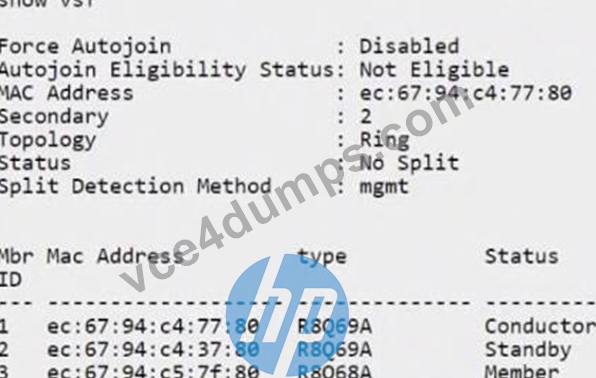
What happens to the member status state if member 1 reboots?
- A. Member 2 becomes Standby
- B. Member 2 becomes Conductor
- C. Member 3 becomes Conductor
- D. Member 3 becomes Standby
Answer: B
Explanation:
The output shows member 1 is the Conductor and member 2 is the Standby. If the Conductor (member 1) reboots, the Standby takes over the control-plane role to maintain stack operation, so member 2 becomes the Conductor.
NEW QUESTION # 36
A Junior Network Engineer is comparing FTP and SFTP for managing switch configurations.
What are the key differences between FTP and SFTP? (Select all that apply.)
- A. SFTP runs over an SSH session, while FTP runs as its own distinct protocol.
- B. FTP is a more recent and secure protocol than SFTP.
- C. SFTP encrypts the entire session, including usernames, passwords, and data.
- D. FTP uses TCP, while SFTP uses UDP.
- E. SFTP is an extension of FTP that adds a layer of SSL/TLS encryption.
Answer: A,C
NEW QUESTION # 37
A Network Technician is running a new cable to a user's desk that is 80 meters from the wiring closet. The connection must support 1Gbps.
Which is the minimum category of Unshielded Twisted Pair (UTP) cable that should be used to guarantee this performance over the required distance?
- A. Cat5
- B. Cat5e
- C. Cat6
- D. Cat3
Answer: B
NEW QUESTION # 38
......
Start your HPE6-A86 Exam Questions Preparation: https://www.vce4dumps.com/HPE6-A86-valid-torrent.html
A Fully Updated HPE6-A86 Exam Dumps - PDF Questions and Testing Engine: https://drive.google.com/open?id=1-7DXzsayJqQgT91VskJ4wGu4Av0XFwR4