


BEST Verified CompTIA CS0-003 Exam Questions (2026)
The Best Practice Test Preparation for the CS0-003 Certification Exam
CompTIA CS0-003 Exam Syllabus Topics:
| Topic | Details |
|---|---|
| Topic 1 |
|
| Topic 2 |
|
| Topic 3 |
|
| Topic 4 |
|
NEW QUESTION # 99
A security analyst has prepared a vulnerability scan that contains all of the company's functional subnets.
During the initial scan, users reported that network printers began to print pages that contained unreadable text and icons.
Which of the following should the analyst do to ensure this behavior does not oocur during subsequent vulnerability scans?
- A. Increase the threshold length of the scan timeout.
- B. Create a tailored scan for the printer subnet.
- C. Ignore embedded web server ports.
- D. Perform non-credentialed scans.
Answer: B
Explanation:
The best way to prevent network printers from printing pages during a vulnerability scan is to create a tailored scan for the printer subnet that excludes the ports and services that trigger the printing behavior. The other options are not effective for this purpose: performing non-credentialed scans may not reduce the impact on the printers; ignoring embedded web server ports may not cover all the possible ports that cause printing; increasing the threshold length of the scan timeout may not prevent the printing from occurring.
NEW QUESTION # 100
The developers recently deployed new code to three web servers. A daffy automated external device scan report shows server vulnerabilities that are failure items according to PCI DSS.
If the venerability is not valid, the analyst must take the proper steps to get the scan clean.
If the venerability is valid, the analyst must remediate the finding.
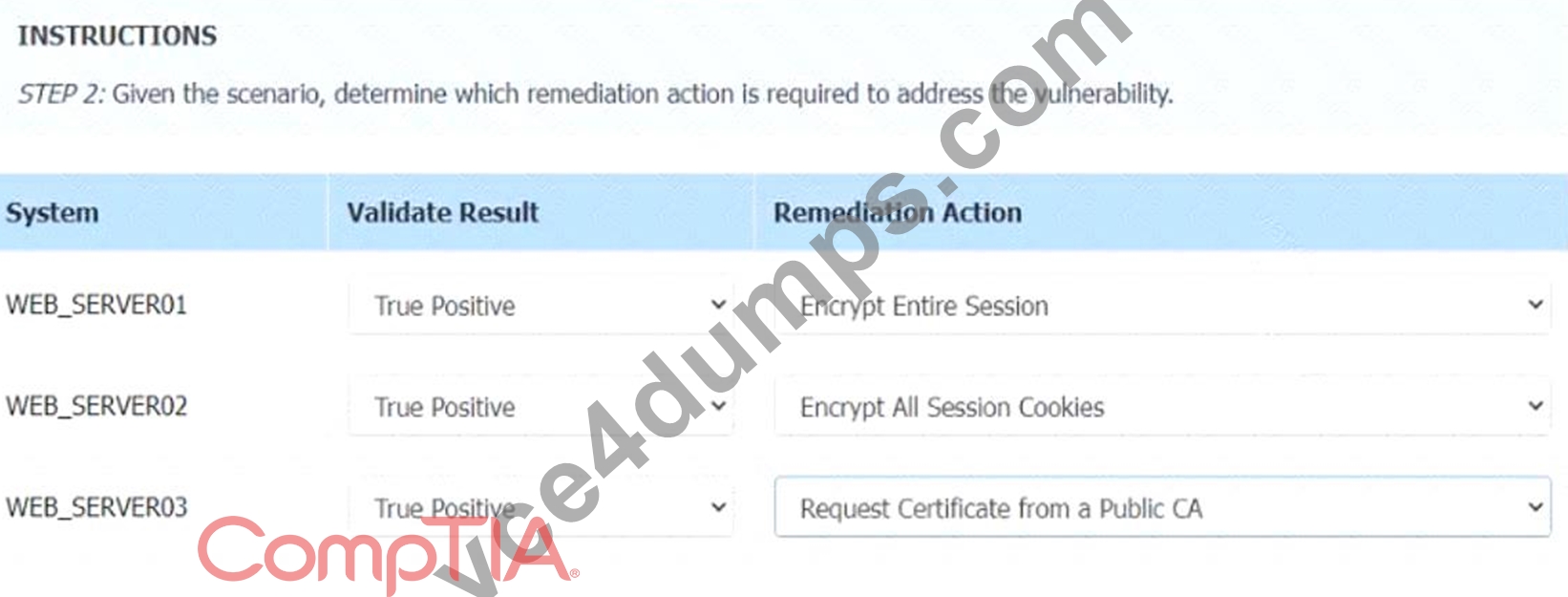
After reviewing the information provided in the network diagram, select the STEP 2 tab to complete the simulation by selecting the correct Validation Result and Remediation Action for each server listed using the drop-down options.
INTRUCTIONS:
The simulation includes 2 steps.
Step1:Review the information provided in the network diagram and then move to the STEP 2 tab.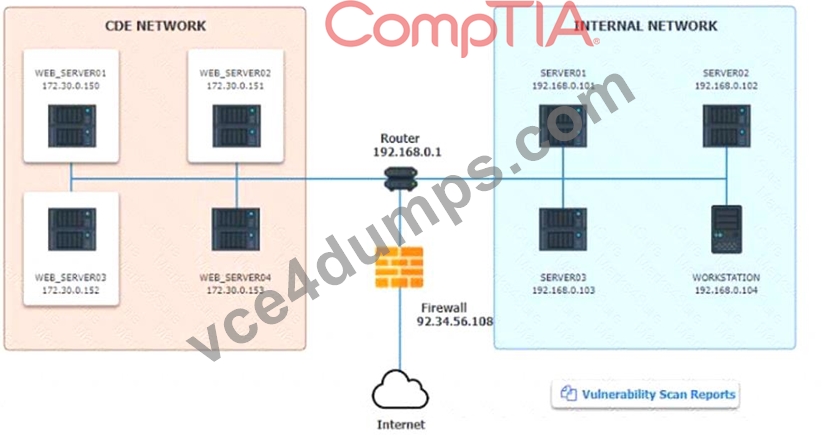
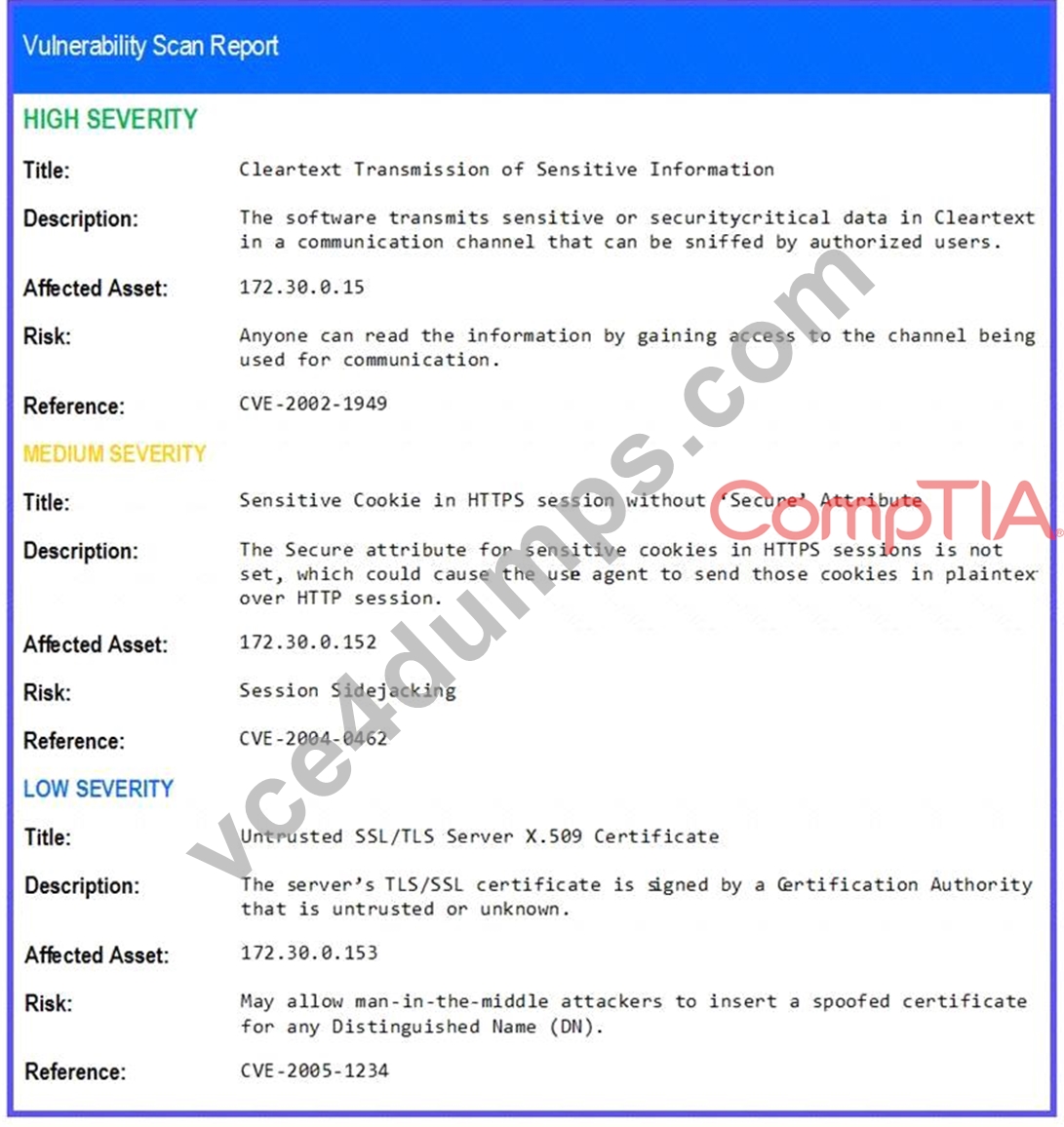
STEP 2: Given the Scenario, determine which remediation action is required to address the vulnerability.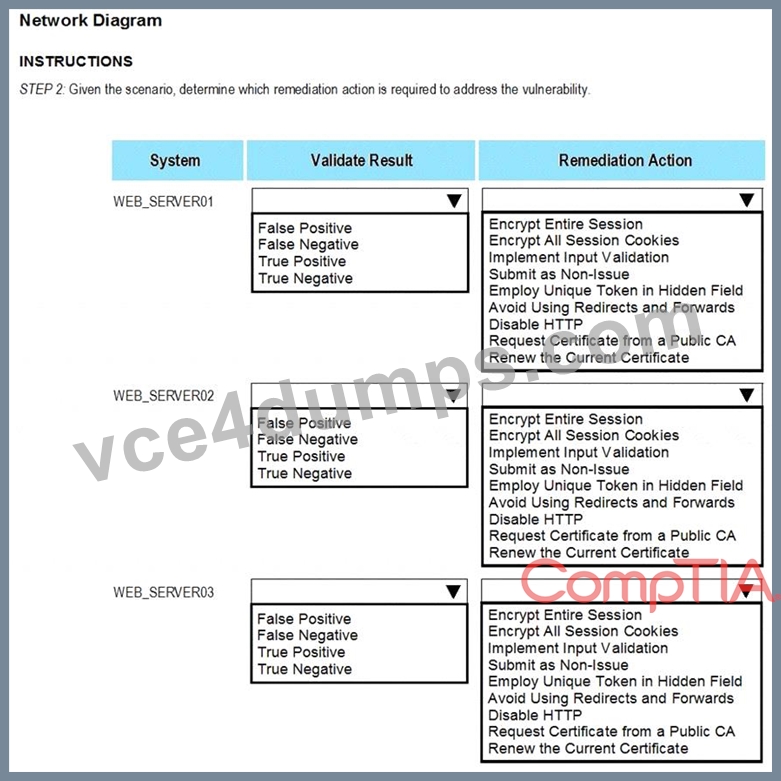
Answer:
Explanation: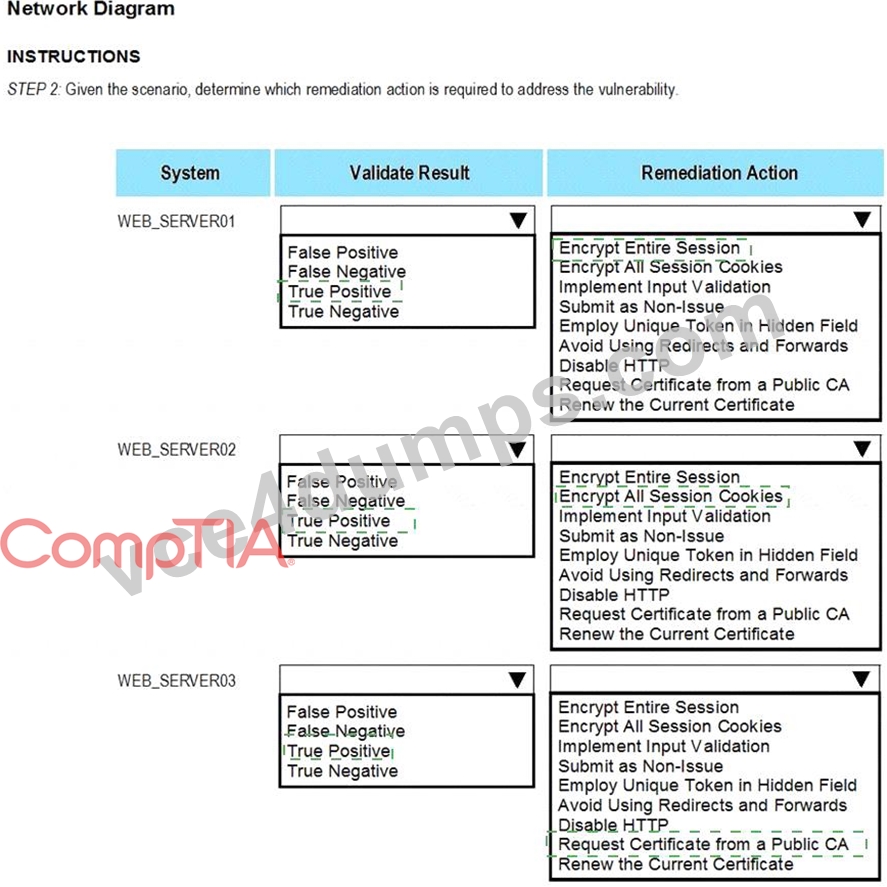
NEW QUESTION # 101
A security analyst receives an alert with the following packet capture attached: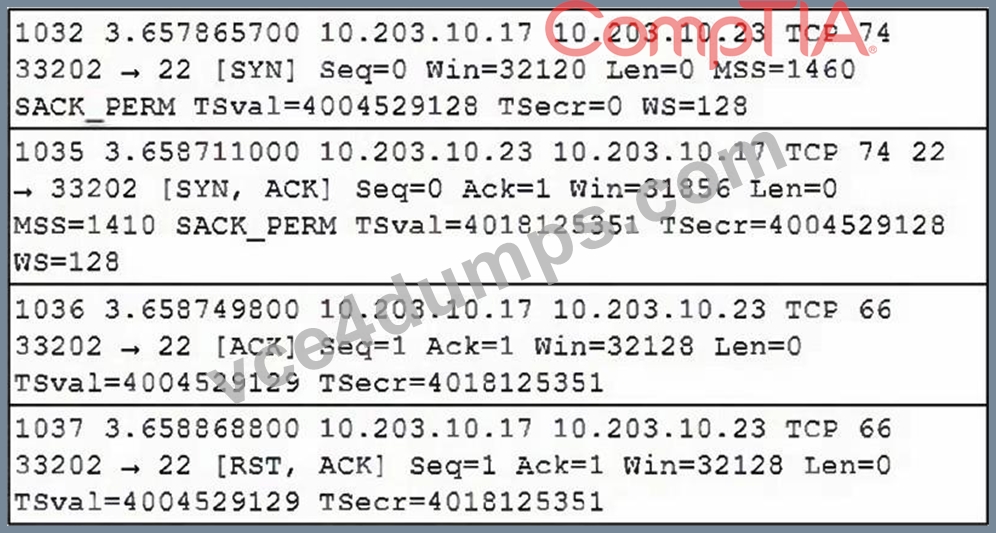
Which of the following has occurred?
- A. A password stuffing attack
- B. An Nmap scan
- C. An ncreverse shell
- D. sslscanreconnaissance
Answer: B
Explanation:
The packet capture shows a TCP three-way handshake (SYN, SYN-ACK, ACK) followed immediately by a RST, ACK, which is characteristic of Nmap's TCP connect scan. This scan type completes the handshake to identify open ports, then quickly resets the connection. The absence of data transfer after the handshake indicates reconnaissance rather than a shell or credential attack.
NEW QUESTION # 102
A virtual web server in a server pool was infected with malware after an analyst used the internet to research a system issue. After the server was rebuilt and added back into the server pool, users reported issues with the website, indicating the site could not be trusted. Which of the following is the most likely cause of the server issue?
- A. The server was supporting weak TLS protocols for client connections.
- B. The malware infected all the web servers in the pool.
- C. The digital certificate on the web server was self-signed.
- D. The server was configured to use SSL to securely transmit data.
Answer: C
Explanation:
A digital certificate is a document that contains the public key and identity information of a web server, and is signed by a trusted third-party authority called a certificate authority (CA). A digital certificate allows the web server to establish a secure connection with the clients using the HTTPS protocol, and also verifies the authenticity of the web server. A self-signed certificate is a digital certificate that is not signed by a CA, but by the web server itself. A self-signed certificate can cause issues with the website, as it may not be trusted by the clients or their browsers.
Clients may receive warnings or errors when trying to access the website, indicating that the site could not be trusted or that the connection is not secure.
NEW QUESTION # 103
The developers recently deployed new code to three web servers. A daffy automated external device scan report shows server vulnerabilities that are failure items according to PCI DSS.
If the venerability is not valid, the analyst must take the proper steps to get the scan clean.
If the venerability is valid, the analyst must remediate the finding.
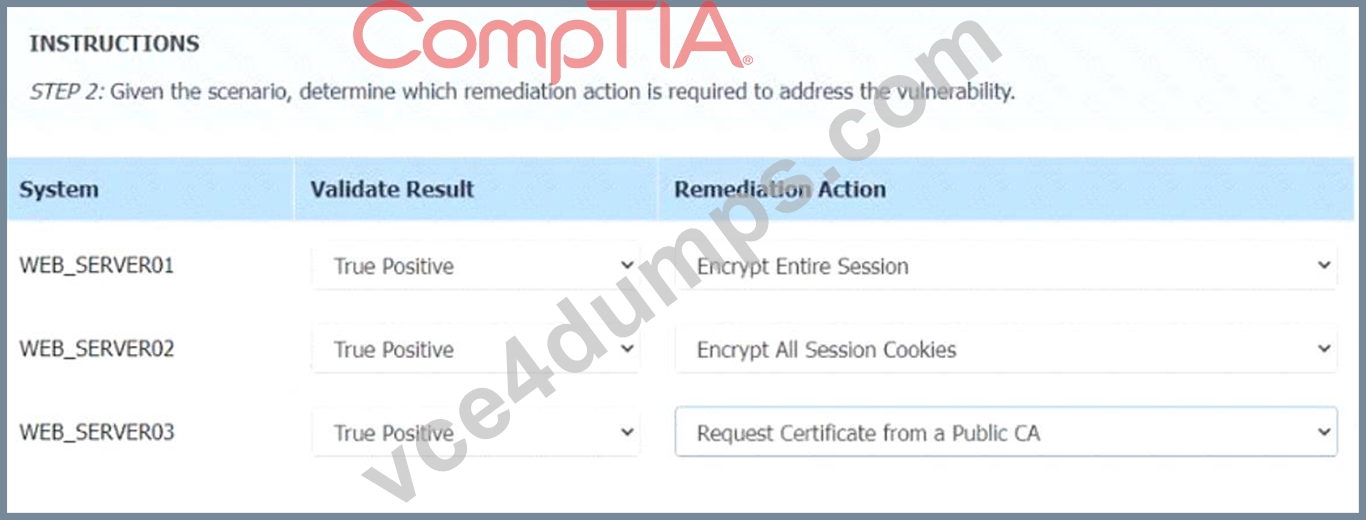
After reviewing the information provided in the network diagram, select the STEP 2 tab to complete the simulation by selecting the correct Validation Result and Remediation Action for each server listed using the drop-down options.
INTRUCTIONS:
The simulation includes 2 steps.
Step1:Review the information provided in the network diagram and then move to the STEP 2 tab.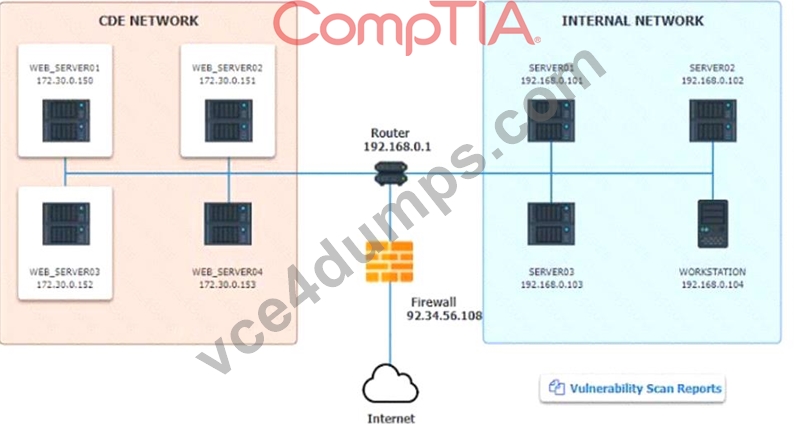
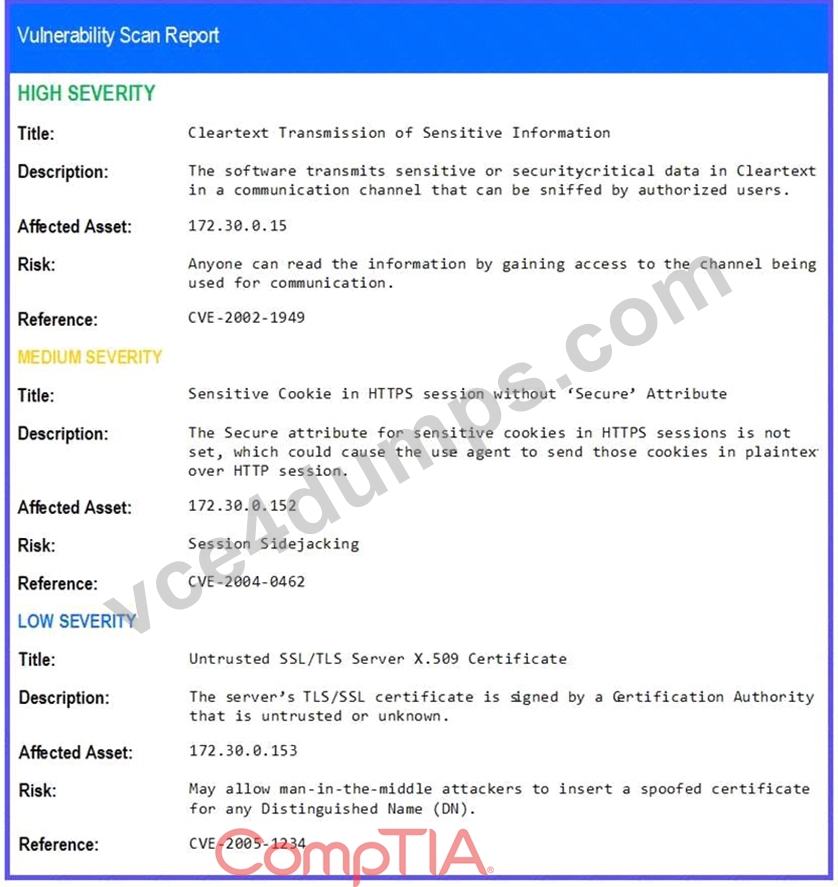
STEP 2: Given the Scenario, determine which remediation action is required to address the vulnerability.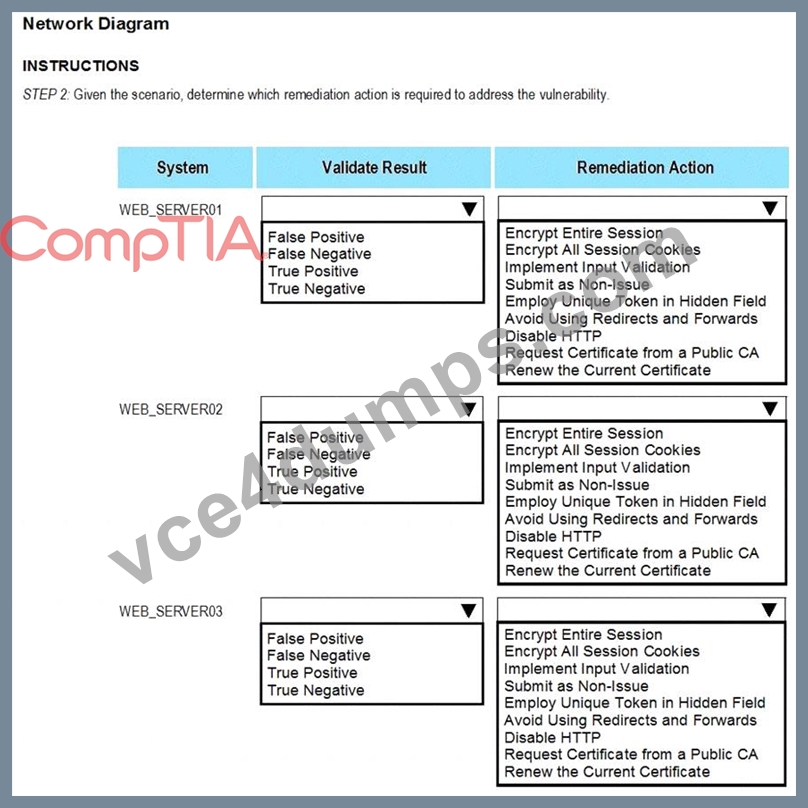
Answer:
Explanation: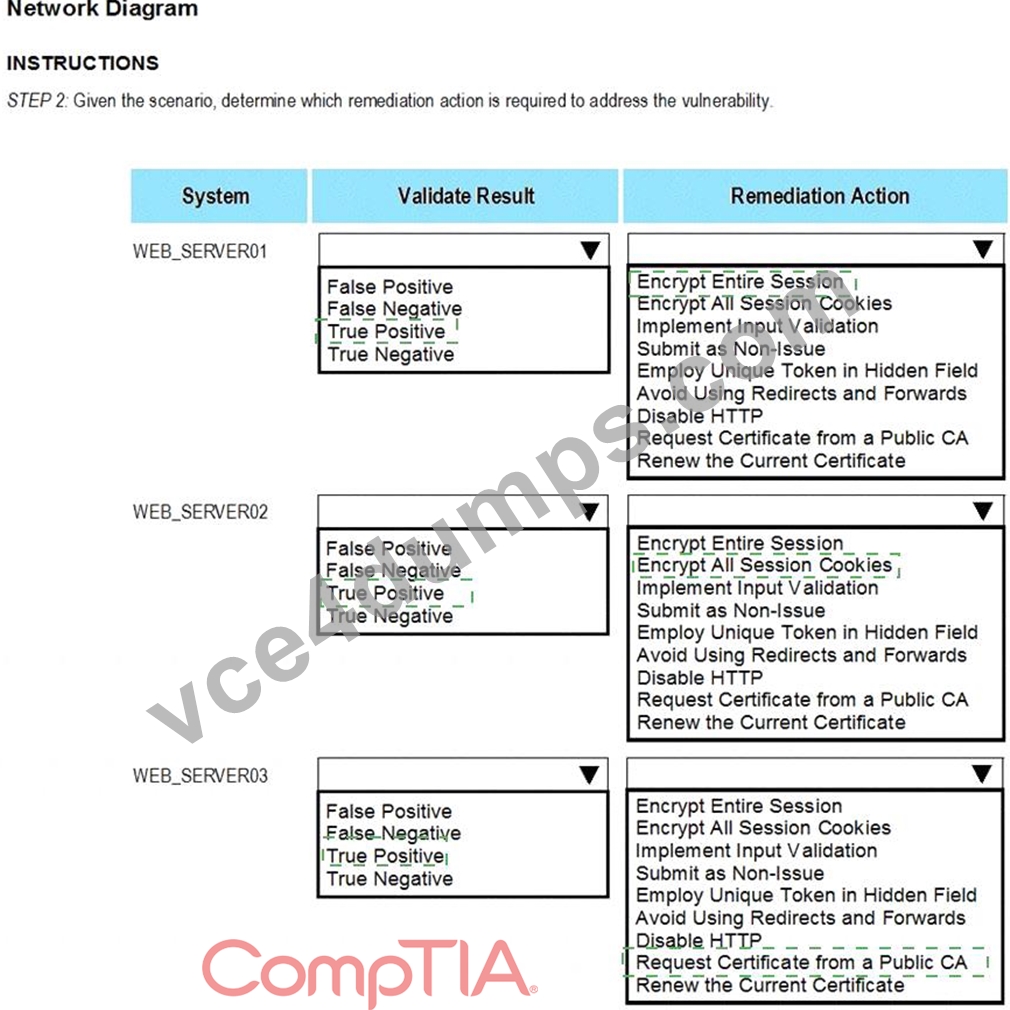
NEW QUESTION # 104
An incident responder was able to recover a binary file through the network traffic. The binary file was also found in some machines with anomalous behavior. Which of the following processes most likely can be performed to understand the purpose of the binary file?
- A. Reverse engineering
- B. Traffic analysis
- C. File debugging
- D. Machine isolation
Answer: A
Explanation:
Reverse engineering is the process of analyzing a binary file to understand its structure, functionality, and behavior. It can help to identify the purpose of the binary file, such as whether it is a malicious program, a legitimate application, or a library. Reverse engineering can involve various techniques, such as disassembling, decompiling, debugging, or extracting strings or resources from the binary file123. Reverse engineering can also help to find vulnerabilities, backdoors, or hidden features in the binary file
NEW QUESTION # 105
During the log analysis phase, the following suspicious command is detected-
Which of the following is being attempted?
- A. ICMP tunneling
- B. Buffer overflow
- C. RCE
- D. Smurf attack
Answer: C
Explanation:
RCE stands for remote code execution, which is a type of attack that allows an attacker to execute arbitrary commands on a target system. The suspicious command in the question is an example of RCE, as it tries to download and execute a malicious file from a remote server using the wget and chmod commands. A buffer overflow is a type of vulnerability that occurs when a program writes more data to a memory buffer than it can hold, potentially overwriting other memory locations and corrupting the program's execution. ICMP tunneling is a technique that uses ICMP packets to encapsulate and transmit data that would normally be blocked by firewalls or filters. A smurf attack is a type of DDoS attack that floods a network with ICMP echo requests, causing all devices on the network to reply and generate a large amount of traffic. Verified Reference: What Is Buffer Overflow? Attacks, Types & Vulnerabilities - Fortinet1, What Is a Smurf Attack? Smurf DDoS Attack | Fortinet2, exploit - Interpreting CVE ratings: Buffer Overflow vs. Denial of ...3
NEW QUESTION # 106
A security manager reviews the permissions for the approved users of a shared folder and finds accounts that are not on the approved access list. While investigating an incident, a user discovers data discrepancies in the file. Which of the following best describes this activity?
- A. Illegal software
- B. Filesystem anomaly
- C. Unauthorized changes
- D. Data exfiltration
Answer: C
Explanation:
The discovery of unapproved accounts accessing shared data, along with data discrepancies, strongly indicates unauthorized changes.
* Indicators of Unauthorized Changes:
* Unexpected user permissions found during audits.
* Modified or deleted data without proper documentation.
* Altered system or security configurations, allowing unintended access.
* Why Not Other Options?
* A. Filesystem Anomaly: This refers to unexpected behavior in the file structure, such as corrupt metadata or missing files, rather than unauthorized user access.
* B. Illegal Software: Would involve unlicensed or unauthorized applications, not unauthorized file modifications.
* D. Data Exfiltration: If data was removed, it might be exfiltration, but in this case, data modifications were detected instead.
To prevent unauthorized changes, security teams should use:
* File Integrity Monitoring (FIM) to detect unauthorized modifications.
* Access control audits to verify correct user permissions.
* SIEM tools to analyze logs for anomalies.
NEW QUESTION # 107
A security analyst identifies a device on which different malware was detected multiple times, even after the systems were scanned and cleaned several times. Which of the following actions would be most effective to ensure the device does not have residual malware?
- A. Download a secondary scanner and rescan the device.
- B. Upgrade the device to the latest OS version.
- C. Update the device and scan offline in safe mode.
- D. Replace the hard drive and reimage the device.
Answer: D
Explanation:
If malware persists after multiple cleanings, the most effective action is to reimage the device from a known good baseline and replace the hard drive if there's suspicion of low-level or boot- sector infection. This ensures complete removal of any hidden or persistent malware.
NEW QUESTION # 108
A security analyst is reviewing events that occurred during a possible compromise. The analyst obtains the following log: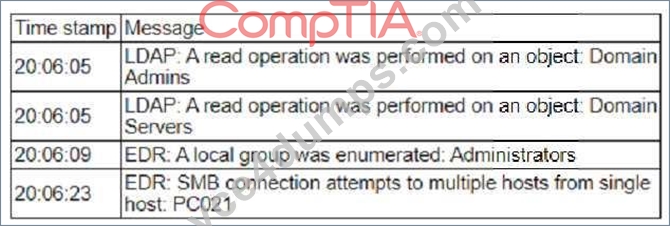
Which of the following is most likely occurring, based on the events in the log?
- A. An adversary is attempting to find the shortest path of compromise.
- B. An adversary is performing a password stuffing attack.
- C. An adversary is performing a vulnerability scan.
- D. An adversary is escalating privileges.
Answer: C
Explanation:
Based on the events in the log, the most likely occurrence is that an adversary is performing a vulnerability scan. The log shows LDAP read operations and EDR enumerating local groups, which are indicative of an adversary scanning the system to find vulnerabilities or sensitive information. The final entry shows SMB connection attempts to multiple hosts from a single host, which could be a sign of network discovery or lateral movement.
NEW QUESTION # 109
Which of the following is an important aspect that should be included in the lessons-learned step after an incident?
- A. Discuss the financial impact of the incident to determine if security controls are well spent
- B. Identify any improvements or changes in the incident response plan or procedures
- C. Determine if an internal mistake was made and who did it so they do not repeat the error
- D. Present all legal evidence collected and turn it over to iaw enforcement
Answer: B
Explanation:
An important aspect that should be included in the lessons-learned step after an incident is to identify any improvements or changes in the incident response plan or procedures. The lessons-learned step is a process that involves reviewing and evaluating the incident response activities and outcomes, as well as identifying and documenting any strengths, weaknesses, gaps, or best practices. Identifying any improvements or changes in the incident response plan or procedures can help enhance the security posture, readiness, or capability of the organization for future incidents
NEW QUESTION # 110
Which of the following threat-modeling procedures is in the OWASP Web Security Testing Guide?
- A. Compliance checks
- B. Review Of security requirements
- C. Decomposing the application
- D. Security by design
Answer: C
Explanation:
The OWASP Web Security Testing Guide (WSTG) includes a section on threat modeling, which is a structured approach to identify, quantify, and address the security risks associated with an application. The first step in the threat modeling process is decomposing the application, which involves creating use cases, identifying entry points, assets, trust levels, and data flow diagrams for the application. This helps to understand the application and how it interacts with external entities, as well as to identify potential threats and vulnerabilities1. The other options are not part of the OWASP WSTG threat modeling process.
NEW QUESTION # 111
A company is in the process of implementing a vulnerability management program, and there are concerns about granting the security team access to sensitive data. Which of the following scanning methods can be implemented to reduce the access to systems while providing the most accurate vulnerability scan results?
- A. Dynamic scanning
- B. Agent-based scanning
- C. Credentialed network scanning
- D. Passive scanning
Answer: B
Explanation:
Agent-based scanning is a method that involves installing software agents on the target systems or networks that can perform local scans and report the results to a central server or console.
Agent- based scanning can reduce the access to systems, as the agents do not require any credentials or permissions to scan the local system or network. Agent-based scanning can also provide the most accurate vulnerability scan results, as the agents can scan continuously or on- demand, regardless of the system or network status or location.
NEW QUESTION # 112
A security analyst finds an application that cannot enforce the organization's password policy. An exception is granted. As a compensating control, all users must confirm that their passwords comply with the organization's policy. Which of the following types of compensating controls is the organization using?
- A. Detective
- B. Corrective
- C. Managerial
- D. Technical
Answer: C
NEW QUESTION # 113
The security analyst received the monthly vulnerability report. The following findings were included in the report:
- Five of the systems only required a reboot to finalize the patch
application
- Two of the servers are running outdated operating systems and cannot
be patched
The analyst determines that the only way to ensure these servers cannot be compromised is to isolate them. Which of the following approaches will best minimize the risk of the outdated servers being compromised?
- A. Maintenance windows
- B. Passive discovery
- C. Compensating controls
- D. Due diligence
Answer: C
Explanation:
Compensating controls are the best approach to minimize the risk of the outdated servers being compromised, as they can provide an alternative or additional layer of security when the primary control is not feasible or effective. Compensating controls are security measures that are implemented to mitigate the risk of a vulnerability or an attack when the primary control is not feasible or effective. For example, if the servers are running outdated operating systems and cannot be patched, a compensating control could be to isolate them from the rest of the network, or to implement a firewall or an intrusion prevention system to monitor and block any malicious traffic to or from the servers. Compensating controls can help reduce the likelihood or impact of an exploit, but they do not eliminate the risk completely. Therefore, the security analyst should also consider upgrading or replacing the outdated servers as soon as possible.
NEW QUESTION # 114
An incident response analyst is taking over an investigation from another analyst. The investigation has been going on for the past few days. Which of the following steps is most important during the transition between the two analysts?
- A. Validate the root cause from the prior analyst.
- B. Identify and discuss the lessons learned with the prior analyst.
- C. Accept all findings and continue to investigate the next item target.
- D. Review the steps that the previous analyst followed.
Answer: D
NEW QUESTION # 115
A company received a shipment of new network switches. Immediately after installing the switches, a security analyst notices suspicious traffic coming from one of the new switches.
Which of the following best describes the threat actor?
- A. Organized crime
- B. Nation-state
- C. Insider threat
- D. Supply chain
Answer: D
Explanation:
The suspicious traffic originating immediately from new, out-of-the-box switches indicates they were likely tampered with before delivery, a classic supply-chain compromise.
NEW QUESTION # 116
......
CompTIA Cybersecurity Analyst (CySA+) Certification, also known as the CS0-003 exam, is a globally recognized certification that validates the knowledge and skills of an individual in the field of cybersecurity analysis. CompTIA Cybersecurity Analyst (CySA+) Certification Exam certification is designed for professionals who wish to specialize in the field of cybersecurity and want to enhance their skills in detecting, preventing, and responding to cybersecurity threats.
CS0-003 Exam Dumps, Practice Test Questions BUNDLE PACK: https://www.vce4dumps.com/CS0-003-valid-torrent.html
CompTIA Cybersecurity Analyst Certification CS0-003 Sample Questions Reliable: https://drive.google.com/open?id=1drZsaUoMOICQE8NP-KlgybpQDFs4F-wf